Well, I'm afraid I have nothing exciting to report. Still catching The Avengers in the theater. Still in an Avengers mood. Still not remotely in the mood for anything else. But it's very pleasant to have something new to obsess over for awhile. Although, musically, I've been mostly listening to the score to Warning Shot (1967) by Jerry Goldsmith. What a relief this score is to me right now. I had been listening to Alan Silvestri's score for Avengers pretty much non-stop, which I honestly do enjoy and still crave, but other than when the theme kicks into gear and the helicarrier cue, there's not much else to hang onto musically or sing to yourself. The score works great in the movie and there's some very nice parts to some of the cues, and really, I am truly and utterly thankful Avengers was scored by somebody competent who understands what a score is supposed to do. But I was randomizing my iTunes the other day and some Goldsmith and Bernstein cues came on, and the difference musically between those older scores and even the entertaining and solid Avengers score is night and day.
And I mourned all over again a world where I can't look forward to a new movie coming out this summer with a Goldsmith score. With great orchestration and melodies to spare.
But at least, there are still some older movies I'm not familiar with whose scores are still being released, and Warning Shot is one of those. I'm extremely fond of Goldsmith's 1960's scores, and the main theme of Warning Shot reminds me of his music for the Flint films which is some of my all-time favorite listening material, so I've been really enjoying this score as a change of pace. And as a reminder of how brilliantly talented the man was. I can't even express in words how I miss him, how his death eight years ago still hurts, how that hole can never be filled. But he left behind a legacy of some of the best music ever written, and that's what I'm enjoying tonight.

Monday, June 18, 2012

Sunday, May 27, 2012
The Avengers and Don Giovanni
Well, my classic movie watching of late has been side-railed by two things: The Avengers and Don Giovanni. Yes, I really loved The Avengers movie. I’ve never read the comic books, and I haven’t seen all the movies that led up to it (though I’ve seen most of them), but this movie was just the kind of movie I’ve been waiting for. Just the right mix of serious and humor, with not too much humor. The right mix of action. Almost no bouncing camera! Hooray and hallelujah! Maybe that trend is finally going away??? Great dialogue. Lots of good-looking actors. All-in-all, it was a thoroughly entertaining way to spend two hours. I’ve already seen it three times and will probably go a couple more times before it leaves the theater. For anyone who knows me well and has seen the movie, then it's pretty obvious that Agent Barton/Hawkeye (played by Jeremy Renner) is my favorite of the Avengers. Who else would I relate to/love? LOL!


As for Don Giovanni, I attended a performance at the Disney Concert Hall last Friday with the LA Phil. The orchestra was good, the singers were good, the production was terrible. The set looked like someone had crumpled giant wads of paper all around, which in and of itself wouldn’t have been too bad – if they’d let the singers act out the story that goes with what they’re singing. But nooooo. Very little of what they did on stage seemed to have anything to do with the story. Even worse, they moved in super-slow-motion or stood around frozen in place, or randomly lay down for entire scenes. Okay, folks. Don Giovanni is a long opera. Do not make it bloody interminable by deliberately slowing the action down even more. I mean I know the opera, I know the story, and I know a fair bit of the libretto. It’s the one Mozart opera I’m rather fond of because it has action – murder, a couple assaults, an avenging statue, very funny exchanges between characters, and the lead character goes to Hell in the end. And when I’m bored, you know the artsy and ridiculously static production ain’t working. And I wasn’t alone in that opinion apparently, as after act one ended, quite a lot of seats were empty for act two. People were bailing out while the getting was good. Unfortunate, because the singers really were good. But opera is neither just music nor just story – it’s both and more, and it all has to work together. I don’t mind operas updated to modern or different time periods, but this was something else entirely.

But, it put the music back in my head, so I’ve been listening to my Simon Keenlyside recording and watching better versions on youtube. And when opera is stuck in my head, I have a hard time watching movies. Although The Avengers is oddly compatible with Don Giovanni, so this combo has been working for me. I alternate listening to Alan Silvestri's score for the movie, and then listening to my favorite scenes from the opera... Yeah, it's pretty weird, but it works.


As for Don Giovanni, I attended a performance at the Disney Concert Hall last Friday with the LA Phil. The orchestra was good, the singers were good, the production was terrible. The set looked like someone had crumpled giant wads of paper all around, which in and of itself wouldn’t have been too bad – if they’d let the singers act out the story that goes with what they’re singing. But nooooo. Very little of what they did on stage seemed to have anything to do with the story. Even worse, they moved in super-slow-motion or stood around frozen in place, or randomly lay down for entire scenes. Okay, folks. Don Giovanni is a long opera. Do not make it bloody interminable by deliberately slowing the action down even more. I mean I know the opera, I know the story, and I know a fair bit of the libretto. It’s the one Mozart opera I’m rather fond of because it has action – murder, a couple assaults, an avenging statue, very funny exchanges between characters, and the lead character goes to Hell in the end. And when I’m bored, you know the artsy and ridiculously static production ain’t working. And I wasn’t alone in that opinion apparently, as after act one ended, quite a lot of seats were empty for act two. People were bailing out while the getting was good. Unfortunate, because the singers really were good. But opera is neither just music nor just story – it’s both and more, and it all has to work together. I don’t mind operas updated to modern or different time periods, but this was something else entirely.

(yes, please, sit around on boxes doing nothing. And why are so many characters dressed in white on a white stage? Are they supposed to blend in and vanish? Grrr.)
But, it put the music back in my head, so I’ve been listening to my Simon Keenlyside recording and watching better versions on youtube. And when opera is stuck in my head, I have a hard time watching movies. Although The Avengers is oddly compatible with Don Giovanni, so this combo has been working for me. I alternate listening to Alan Silvestri's score for the movie, and then listening to my favorite scenes from the opera... Yeah, it's pretty weird, but it works.
Friday, May 18, 2012
The Seven-Per-Cent Solution (1976)
This is my favorite Sherlock Holmes film to date, with my favorite portrayal of Holmes. Why? Easy. Because of the outstanding script by Nicolas Meyer and the brilliant performances by Nicol Williamson as Holmes and Alan Arkin as Sigmund Freud. The rest of the cast is big name: Robert Duvall plays Watson, Vanessa Redgrave plays the lady in distress, and Lawrence Olivier puts in a turn as Moriarty.

Nicolas Meyer is also responsible for the script to Time After Time (on my top 25 films list), as well as my two favorite movies in the Star Trek series, II (Wrath of Khan) and VI (The Undiscovered Country). I don't think I've seen anything written (or directed) by Nicolas Meyer that I did not like. Both Time After Time and The Seven-Per-Cent Solution deal with a mix of characters. In Time After Time, it's H.G. Wells and Jack the Ripper, in The Seven-Per-Cent Solution, it's Sherlock Holmes and Sigmund Freud.
The Seven-Per-Cent Solution is a darker entry into the Holmes film, in that it deals with Holmes's cocaine addiction. The plot concerns Watson and Holme's brother, Mycroft, concocting a scheme to get Holmes to Vienna, where he can be treated for his addiction by Freud, who has successfully helped others, including himself, overcome the addiction. As Holmes fights to kick the habit, he takes on a case regarding a missing woman, with Freud stepping up to the sleuthing plate, every bit as brilliant in his own way as Holmes is. It makes for a fabulous, entertaining partnership. The first half of the film deals more with the addiction, the second half deals more of the action of solving the mystery, though both are well-balanced, and the film has always engaged me the entire way. It makes particularly interesting use of Moriarty as well, not as the villain, but as a mathematics tutor from Holmes's childhood involved in a tragic incident. I've never seen Moriarty as anything but the evil mastermind, and this different kind of nemesis is very refreshing.
The depth of Williamson's portrayal as Holmes never ceases to amaze me. From the manic, obsessed-with-Moriarty, drug-addicted Holmes, to the recovered, calm and decisive Holmes, Williamson moves smoothly, brilliantly, and without a misstep between the disparate facets of the character. He was a first-class actor who really got to shine here. And, as usual with a Nicolas Meyer script, there's also real meat to the characters that an actor can dig into.

Alan Arkin is equally awesome as Freud, committed to helping Sherlock Holmes recover. As they get more embroiled in the mystery aspects, it always makes me smile as the intelligence of both men both clashes and meshes. I can never decide which character and performance is my favorite, Arkin as Freud, or Williamson as Holmes. They're both perfect.

There's plenty of action too, from a duel between Freud and a German baron -- fought on a tennis court! -- to the big train chase finale, which includes a sword fight on top of the moving train. The train chase across the European countryside is definitely my favorite part of the film. It's perfectly paced to keep you on the edge of your seat, and satisfy a viewer with each step along the way to the conclusion.

I think this might have been the first film I saw Robert Duvall in, isn't that odd? He is a credible Watson, worried and steadfast. He doesn't have that much to do, compared to Holmes and Freud. It is a bit weird to hear him with a (admittedly) bad British accent. It doesn't detract from the film for me, though, just sounds weird!
I love John Addison's score to this film as well. I've seen other films with his scores, but none stuck in my head like this one. I think he exactly nailed the right emotional tone this movie required, and I'm particularly fond of the train chase music.
This movie comes very close to making my top 25 favorite film list; in fact, it used to be on it, but alas, something has to drop off the list when new movies come along! This movie isn't for everyone because of the drug addiction, but it's one of which I never tire.

Nicolas Meyer is also responsible for the script to Time After Time (on my top 25 films list), as well as my two favorite movies in the Star Trek series, II (Wrath of Khan) and VI (The Undiscovered Country). I don't think I've seen anything written (or directed) by Nicolas Meyer that I did not like. Both Time After Time and The Seven-Per-Cent Solution deal with a mix of characters. In Time After Time, it's H.G. Wells and Jack the Ripper, in The Seven-Per-Cent Solution, it's Sherlock Holmes and Sigmund Freud.
The Seven-Per-Cent Solution is a darker entry into the Holmes film, in that it deals with Holmes's cocaine addiction. The plot concerns Watson and Holme's brother, Mycroft, concocting a scheme to get Holmes to Vienna, where he can be treated for his addiction by Freud, who has successfully helped others, including himself, overcome the addiction. As Holmes fights to kick the habit, he takes on a case regarding a missing woman, with Freud stepping up to the sleuthing plate, every bit as brilliant in his own way as Holmes is. It makes for a fabulous, entertaining partnership. The first half of the film deals more with the addiction, the second half deals more of the action of solving the mystery, though both are well-balanced, and the film has always engaged me the entire way. It makes particularly interesting use of Moriarty as well, not as the villain, but as a mathematics tutor from Holmes's childhood involved in a tragic incident. I've never seen Moriarty as anything but the evil mastermind, and this different kind of nemesis is very refreshing.
The depth of Williamson's portrayal as Holmes never ceases to amaze me. From the manic, obsessed-with-Moriarty, drug-addicted Holmes, to the recovered, calm and decisive Holmes, Williamson moves smoothly, brilliantly, and without a misstep between the disparate facets of the character. He was a first-class actor who really got to shine here. And, as usual with a Nicolas Meyer script, there's also real meat to the characters that an actor can dig into.

Alan Arkin is equally awesome as Freud, committed to helping Sherlock Holmes recover. As they get more embroiled in the mystery aspects, it always makes me smile as the intelligence of both men both clashes and meshes. I can never decide which character and performance is my favorite, Arkin as Freud, or Williamson as Holmes. They're both perfect.

There's plenty of action too, from a duel between Freud and a German baron -- fought on a tennis court! -- to the big train chase finale, which includes a sword fight on top of the moving train. The train chase across the European countryside is definitely my favorite part of the film. It's perfectly paced to keep you on the edge of your seat, and satisfy a viewer with each step along the way to the conclusion.

I think this might have been the first film I saw Robert Duvall in, isn't that odd? He is a credible Watson, worried and steadfast. He doesn't have that much to do, compared to Holmes and Freud. It is a bit weird to hear him with a (admittedly) bad British accent. It doesn't detract from the film for me, though, just sounds weird!
I love John Addison's score to this film as well. I've seen other films with his scores, but none stuck in my head like this one. I think he exactly nailed the right emotional tone this movie required, and I'm particularly fond of the train chase music.
This movie comes very close to making my top 25 favorite film list; in fact, it used to be on it, but alas, something has to drop off the list when new movies come along! This movie isn't for everyone because of the drug addiction, but it's one of which I never tire.
Thursday, May 17, 2012
Without a Clue (1988)
Wow, did this movie really come out that long ago? I've been thinking a bit about Sherlock Holmes lately, and over the weekend watched two of my favorite Holmes movies that I own on DVD. This is one of them. This movie is such a delight. It stars Michael Caine as Holmes and Ben Kingsley as Watson... only this story runs with the idea that Watson is really the detective. But because he was a doctor looking for a good position, he couldn't very well use his own name in all those stories he was publishing, so he created the fictional character of Sherlock Holmes. When the stories become a gigantic success, he is forced to hire an out-of-work, drunken actor, Reginald Kincaid (Michael Caine), to play Holmes for the public. When Watson attempts to dispose of the actor and announce to the public that he's the true detective, he finds that it's too late: Sherlock Holmes is the only one the public will accept. So he brings Holmes back for one more case, involving a counterfeit money scheme Moriarty (played by Paul Freeman) is attempting to pull off.
This movie could not have been more perfectly cast. Oscar-winners Michael Caine and Ben Kingsley make this movie. Caine is thoroughly wonderful as the amiable, but inept actor forced to memorize myriad clues and info every day in order to pull the role of Holmes. Kingsley is just as wonderful as the real brain, with little patience for the antics of the actor he's hired. Of course, they end up helping each other, and, of course, Michael Caine will have to step up to the plate and attempt some real sleuthing... with hilarious and satisfying results. I can't imagine anyone playing this version of Holmes better than Michael Caine.

It's well-known I'm not so big on comedy, but this one plays just right for me. The natural humor comes from the situations the characters get into and their personalities, which always works better. The dialogue is smart and funny and doesn't get old, no matter how many times I see this movie. There's some physical humor too, but it's not overdone. It's quite an old-fashioned film, really, and I love it.
This movie could not have been more perfectly cast. Oscar-winners Michael Caine and Ben Kingsley make this movie. Caine is thoroughly wonderful as the amiable, but inept actor forced to memorize myriad clues and info every day in order to pull the role of Holmes. Kingsley is just as wonderful as the real brain, with little patience for the antics of the actor he's hired. Of course, they end up helping each other, and, of course, Michael Caine will have to step up to the plate and attempt some real sleuthing... with hilarious and satisfying results. I can't imagine anyone playing this version of Holmes better than Michael Caine.

It's well-known I'm not so big on comedy, but this one plays just right for me. The natural humor comes from the situations the characters get into and their personalities, which always works better. The dialogue is smart and funny and doesn't get old, no matter how many times I see this movie. There's some physical humor too, but it's not overdone. It's quite an old-fashioned film, really, and I love it.
Monday, April 30, 2012
Meme-ish things - the letter M
via Rabia Gale:
How to Play: Comment to this entry and I’ll give you a letter. List ten things that you love that begin with that letter and then post that list on your journal.
My List: Ten Things I Love That Begin With The Letter M
(I'm leaving off Movies and Music here, because those kind of go without saying)
1. Mario Cavaradossi (my all-time favorite opera character)
How to Play: Comment to this entry and I’ll give you a letter. List ten things that you love that begin with that letter and then post that list on your journal.
My List: Ten Things I Love That Begin With The Letter M
(I'm leaving off Movies and Music here, because those kind of go without saying)
1. Mario Cavaradossi (my all-time favorite opera character)
2. Maps (reading them, studying them, memorizing them, making them)
3. Masada (the score by Jerry Goldsmith, that is)
4. Meteorites (looking at them, holding them, hunting them...)
5. Milnes, Sherill (my favorite baritone, what a voice)
6. Memories (what is life, but a series of?)
7. Mountains (I'm most alive and at home in the mountains, particularly the Sierra Nevada)
8. Maximus (my Husky)
9. Musketeers (particularly that Athos guy)
10. Mythology (I think I have more books on mythology than just about any other subject except submarines)
Friday, April 20, 2012
25 All-time favorite movies
I haven't ever posted a list of my favorite movies here. It's probably about time. My list will probably surprise a lot of people, as despite the sheer quantity of classic movies I love, they don't actually tend to make my favorites list. There are reasons for that.
I think that word “favorite” means different things to different people. What makes a favorite movie to me is something above and beyond what makes me simply love a movie. There are many movies I absolutely love and adore (and I’ve seen them enough times you’d think they were favorites) – but they don’t actually make the favorites cut. Why? Well, it’s actually easy to explain:
I think that word “favorite” means different things to different people. What makes a favorite movie to me is something above and beyond what makes me simply love a movie. There are many movies I absolutely love and adore (and I’ve seen them enough times you’d think they were favorites) – but they don’t actually make the favorites cut. Why? Well, it’s actually easy to explain:
For me, “favorite movie” means:
1) a film with which I have a special, emotional
bond. Favorite movies move me emotionally
in ways movies I simply love have not. I am
passionate about them, and quite a few of them have changed my life in various ways.
2) a film I have seen many many
times, often in the theater. This is why
quite a few of my favorites are newer films – I bonded with them over repeat
viewings in the movie theater when they came out.
3) a movie with a score that matters deeply to me. This may seem odd, but the musical element is almost more important than any other piece. The score is part of what forms that emotional bond with a film. The soundtrack alone is often the difference between a well-loved movie and a favorite movie, and is one of the primary reasons many of the older 1940's films I love don't make the favorites list. I simply don't love their music the way I do other films. With only one exception (and that's only because the CD is currently out of print), I own the scores to every film on this list. I sing the scores, I listen to the scores, I hum them, I live and breathe them. Many of the scores to the movies listed below rank among my top favorite music of all time. So yeah, music really is one of the most important things in my life, and that applies absolutely to movies.
3) a movie with a score that matters deeply to me. This may seem odd, but the musical element is almost more important than any other piece. The score is part of what forms that emotional bond with a film. The soundtrack alone is often the difference between a well-loved movie and a favorite movie, and is one of the primary reasons many of the older 1940's films I love don't make the favorites list. I simply don't love their music the way I do other films. With only one exception (and that's only because the CD is currently out of print), I own the scores to every film on this list. I sing the scores, I listen to the scores, I hum them, I live and breathe them. Many of the scores to the movies listed below rank among my top favorite music of all time. So yeah, music really is one of the most important things in my life, and that applies absolutely to movies.
On this list, the top seven movies haven't changed in years. Nothing really displaces those films, particularly the top three, which I don't think will ever budge. The rest of the movies change order depending on my mood.
1. 20,000 Leagues Under the Sea (1954)
2. The Dirty Dozen (1967)
3. Big Jake (1971)
4. The Empire Strikes Back (1980)
5. The Thirteenth Warrior (1999)
6. The Wind and the Lion (1975)
7. The Flight of the Phoenix (1965)
8. Ben-Hur (1959)
9. The Fellowship of the Ring (2001)
10. The Wild Bunch (1969)
11. Aliens (1986)
12. The Hunt for Red October (1990)
13. Galaxy Quest (1999)
14. Raiders of the Lost Ark (1981)
15. Star Wars (1977)
16. The Mask of Zorro (1998)
17. The Untouchables (1987)
18. Avatar (2009)
19. The Vikings (1958)
20. Time After Time (1979)
21. Where Eagles Dare (1968)
22. South Pacific (1958)
23. The Shadow (1994)
24. Ride the High Country (1962)
25. Diamonds are Forever (1965)
Thursday, April 19, 2012
Seriously?
I found bloggers's old dashboard is toast as of today, and I'm stuck with this new and not streamlined, not easier to use interface. This is the second time this week that what used to be a lovely webpage has been totally changed. The other is USGS's recent earthquake page, the changes to which vex me far more than the changes here. They've made their site damn near unusable compared to what it used to be. This looks like just a pain to re-learn and find where everything went. Like so far, I haven't located where they moved all the blogs I follow. I'm sure it's here. I just need to poke and click on everything until I find it. I work for a software company, so I know why software changes... but that doesn't mean I like it. Not one bit.
Yeah, frustrated.
Yeah, frustrated.
Friday, April 13, 2012
The Toast of New Orleans (1950)
I recently watched this second film of Mario Lanza's, and when I say 'watched,' I mean that rather literally, as I didn't actually get to hear much of the movie beyond the singing. This is the problem when there's a four-year-old around and I wanted to watch it with my sister, and we fit it in... but the volume on the dvd seemed very quiet and was overridden by household and playing child noises. And, I admit, it was easy enough to follow without the dialogue, and it wasn't good enough to re-watch on my own with the volume at a proper level.
That's not to say it wasn't enjoyable along the same lines as That Midnight Kiss. In fact, it really does play exactly like they said "Wow, we got a hit on our hands, let's repeat the formula!" which I believe is what had really happened. This go-around shifts setting, and adds David Niven (who's rather delightful as the bemused opera director), but is otherwise very similar, right down to an inexplicable twenty-second (literally) happy wrap-up that comes out of nowhere. Lots of singing, quite a bit of dancing (Rita Moreno co-stars), and lots of light, romantic entertainment.
 Highlights for me were Lanza singing the Flower Song from Carmen and the finale of the movie, which was a performance of the love duet at the end of the first act of Butterfly. He makes a perfect Pinkerton, both in looks and voice. In this movie, Mario Lanza reminded my sister and me of a cross between Desi Arnaz and William Shatner. With a really good voice.
 We also had great fun waiting to see what dress Kathryn Grayson would be wearing next. These barely begin to capture the gowns and dresses she wore in this movie!


Another movie I'm glad I saw, but wouldn't need to own.
The DVD also included an hour biography on Mario Lanza, which we watched at a different time, and were actually able to hear. What a sad, short life he had! It made me very sad to watch this man of incredible talent and see how the world he inhabited, and his own tremendous insecurities, brought him down. How after he was planted in Hollywood, he did want to go sing on stage, but was scared to, particularly as he was compared so often to Caruso -- how would anyone ever measure up to those expectations? His weight was a constant issue. As they said, he sang better when he was heavy, but he filmed better when he was thin, so he would go on these horrible diets and lose 60 lbs. in a couple months, really unhealthy. And there was alcohol, a whole lot of it. He died at just 38 years old; his wife died a mere 5 months later. So sad.
There were quite a few clips from his later movies, were he was more serious and actually go to act, and I really want to see those now. And boy, when he sings opera straight, wow. He really did have an amazing voice. These stills were in the biography and I really liked them.
 (Mario and Tyrone! Love this shot, particularly as Tyrone is still my Hollywood wish-he-was-an-opera-tenor Hollywood star.)


I also really like this one quote. He was talking about that moment when he would go on stage:
"I feel that it's such an exciting thing. It's a thing that brings so much beauty, to those who, at the moment, love what they're experiencing. And in it's way, isn't it true that it's beautiful, that moment of excitement?"
This expresses something that I find lacking a lot today, an appreciation of beauty. A need and a love of beautiful things/moments/etc. I recently tried to explain why I would cry at beautiful things -- such as an especially pretty moment in an opera, or a sunset, or a gorgeous view. The person I was speaking with just looked at me blankly. But beautiful things did not move them, did not matter to them, in a way they matter to me. I listen to this quote from Mario Lanza and it just resonates.
That's not to say it wasn't enjoyable along the same lines as That Midnight Kiss. In fact, it really does play exactly like they said "Wow, we got a hit on our hands, let's repeat the formula!" which I believe is what had really happened. This go-around shifts setting, and adds David Niven (who's rather delightful as the bemused opera director), but is otherwise very similar, right down to an inexplicable twenty-second (literally) happy wrap-up that comes out of nowhere. Lots of singing, quite a bit of dancing (Rita Moreno co-stars), and lots of light, romantic entertainment.
 Highlights for me were Lanza singing the Flower Song from Carmen and the finale of the movie, which was a performance of the love duet at the end of the first act of Butterfly. He makes a perfect Pinkerton, both in looks and voice. In this movie, Mario Lanza reminded my sister and me of a cross between Desi Arnaz and William Shatner. With a really good voice.
 We also had great fun waiting to see what dress Kathryn Grayson would be wearing next. These barely begin to capture the gowns and dresses she wore in this movie!


(my personal favorite was this green velvet gown.)
Another movie I'm glad I saw, but wouldn't need to own.
The DVD also included an hour biography on Mario Lanza, which we watched at a different time, and were actually able to hear. What a sad, short life he had! It made me very sad to watch this man of incredible talent and see how the world he inhabited, and his own tremendous insecurities, brought him down. How after he was planted in Hollywood, he did want to go sing on stage, but was scared to, particularly as he was compared so often to Caruso -- how would anyone ever measure up to those expectations? His weight was a constant issue. As they said, he sang better when he was heavy, but he filmed better when he was thin, so he would go on these horrible diets and lose 60 lbs. in a couple months, really unhealthy. And there was alcohol, a whole lot of it. He died at just 38 years old; his wife died a mere 5 months later. So sad.
There were quite a few clips from his later movies, were he was more serious and actually go to act, and I really want to see those now. And boy, when he sings opera straight, wow. He really did have an amazing voice. These stills were in the biography and I really liked them.
 (Mario and Tyrone! Love this shot, particularly as Tyrone is still my Hollywood wish-he-was-an-opera-tenor Hollywood star.)
(Mario and his wife - so cute)

(Mario and his wife again... love them reading Hemingway, even if it is a publicity shot)

(This shot is so beautifully framed, and so sad. Seems to capture how trapped he was.)
I also really like this one quote. He was talking about that moment when he would go on stage:
"I feel that it's such an exciting thing. It's a thing that brings so much beauty, to those who, at the moment, love what they're experiencing. And in it's way, isn't it true that it's beautiful, that moment of excitement?"
This expresses something that I find lacking a lot today, an appreciation of beauty. A need and a love of beautiful things/moments/etc. I recently tried to explain why I would cry at beautiful things -- such as an especially pretty moment in an opera, or a sunset, or a gorgeous view. The person I was speaking with just looked at me blankly. But beautiful things did not move them, did not matter to them, in a way they matter to me. I listen to this quote from Mario Lanza and it just resonates.
Friday, April 06, 2012
The Lamp Still Burns (1943)
I quite liked this little drama, about a female and successful architect who drops everything to become a nurse during WWII. Rosamund John is very likeable as the protagonist, Hilary Clarke. When she decides she wants to help people as a nurse instead, she commits fully with passion and perseverance. I can't help but admire someone willing to give up everything for the hardships and privations nurses-in-training had to go through.
 Stewart Granger seems ridiculously young in this movie, and while his is definitely a supporting role, it's still a critical one. His character, Laurence Rains, works with Hilary in the beginning of the film when she's still in her architect capacity, and he's quite taken with her, even though he's engaged to another woman. He next encounters her when there's an accident at his plant, and then things go terribly wrong and he and his fiancee both get caught in an explosion at his plant and end up in the hospital Hilary is training at, under her care. The rest of the story deals with how the love triangle intersects with Hilary's commitment to the nursing profession.
 I did not know how harsh and strict the conditions for nurses in England at this time was. The sheer amount restrictions and rules are astounding. Definitely not something I could have done, which just made me admire Hilary even more. I love strong, passionate female characters. She is faced with some horrible decisions that no one should have to make. I quite liked the other nurses as well, and the various patients all had personalities. It's a movie I will definitely watch again at some point.
It's funny. I watch plenty of movie violence and it doesn't bother me, but one long scene in this movie, a surgery -- which shows ZERO gore or blood -- got to me. It was more the sounds and concept of what was going on that wigged me out. I'm sure the fact that it was Laurence Rains on the operating table was a big part of it. Since this wasn't a Hollywood movie and happy endings are not remotely guaranteed in British movies, I had no idea if he'd make it, and worrying over his character was freaking me out. I think that was one of the strong points of this movie: I cared a very great deal about all the characters. The movie made their fates matter to me, and I love that about the film. (And did he make it, you ask? Well, you'll just have to watch the movie!)
 Stewart Granger seems ridiculously young in this movie, and while his is definitely a supporting role, it's still a critical one. His character, Laurence Rains, works with Hilary in the beginning of the film when she's still in her architect capacity, and he's quite taken with her, even though he's engaged to another woman. He next encounters her when there's an accident at his plant, and then things go terribly wrong and he and his fiancee both get caught in an explosion at his plant and end up in the hospital Hilary is training at, under her care. The rest of the story deals with how the love triangle intersects with Hilary's commitment to the nursing profession.
 I did not know how harsh and strict the conditions for nurses in England at this time was. The sheer amount restrictions and rules are astounding. Definitely not something I could have done, which just made me admire Hilary even more. I love strong, passionate female characters. She is faced with some horrible decisions that no one should have to make. I quite liked the other nurses as well, and the various patients all had personalities. It's a movie I will definitely watch again at some point.
It's funny. I watch plenty of movie violence and it doesn't bother me, but one long scene in this movie, a surgery -- which shows ZERO gore or blood -- got to me. It was more the sounds and concept of what was going on that wigged me out. I'm sure the fact that it was Laurence Rains on the operating table was a big part of it. Since this wasn't a Hollywood movie and happy endings are not remotely guaranteed in British movies, I had no idea if he'd make it, and worrying over his character was freaking me out. I think that was one of the strong points of this movie: I cared a very great deal about all the characters. The movie made their fates matter to me, and I love that about the film. (And did he make it, you ask? Well, you'll just have to watch the movie!)
Thursday, April 05, 2012
Salome (1953)
I admit it: I'm a sucker for Biblical epics. Good or bad, overblown or great, melodramatic or understated or just perfect... I tend to enjoy them all. I love the vivid colors, the sumptuous costumes, the setting, the hair styles. Salome was more enjoyable than I expected. Hard to go wrong with the cast: Charles Laughton, Judith Anderson, Stewart Granger, and Rita Hayworth in the lead roles. But the script surprised me with some really good dialogue. That's not to say it didn't have its over-the-top factor (John the Baptist... I'm looking at you and your wild eyes!), but that's also part of the fun of Biblical epics.
 (Charles Laughton makes a most excellent Herod. I also really love this shot of him.)
 (Judith Anderson is perfect as the cold, desperate, scheming Herodias)
I wasn't quite sure how Stewart Granger would fit in when I started watching, but they worked him in all right, and he had plenty of screen time in his Roman outfits to keep me happy. And really, they certainly paired Granger up with some of the most lovely women in Hollywood! What a handsome couple he and Rita make!
 Spoilers follow...
The plot surprised me a bit. I guess I've gotten used to Rita playing the femme fatale types, and Salome and her dance of the seven veils for the head of John the Baptist just all fit together nicely with that image... only they changed that. In this version, she dances to save him! Knock me over with a feather, what?? That was unexpected. I was also expecting her to somehow get Stewart Granger's character killed... she's good at that, and he's good at picking the wrong women and getting killed because of it... nope. They both seem to live happily ever after, and together, no less! The entire ending rather shocked me. Not that I object to happy endings, quite the contrary, it just didn't fit with the story of Salome I was expecting. I mean, who thinks "good girl" when they think of Salome?

 (no, this is more like it!)
Granger's character was also a good guy, though that I was expecting. His Roman Commander Claudius has secretly converted to Christianity, so he helps slaves, John the Baptist, and whoever else he can, getting himself kicked out of the Roman army when he openly admits it to his boss (Pontius Pilate, played with strength and unexpected compassion -- at least when around Granger -- by Basil Sydney, who I last saw playing Captain Smollett in the 1950 version of Treasure Island, really like him!). That was one of the small things that bugged me though. Claudius is ordered to take ship for Rome, and he promptly goes AWOL instead, returning to Galilee. And nothing comes from this open defiance of his orders. It's only his friendship with Pilate that prevented him from being executed for treason in the first place, and no one follows to arrest him or anything?? And he's still looking awfully Roman in the last shot of the film, no hiding out by blending in with the natives. Too bad. I'd kind of like to see a few consequences from his desertion. But, of course, I daydream. This movie is not called "Claudius," it's called "Salome."
 All in all, it was a diverting couple of hours, and definitely better than quite a few other movies in this genre, and it fits the season. I think I automatically start looking for these types of movies come Easter, as television stations used to run the gamut of Biblical epics this time of year.
 (Okay, I also admit that when Stewart Granger looks this good, I wasn't paying much attention to anyone else in the movie...)
 (Charles Laughton makes a most excellent Herod. I also really love this shot of him.)
 (Judith Anderson is perfect as the cold, desperate, scheming Herodias)
I wasn't quite sure how Stewart Granger would fit in when I started watching, but they worked him in all right, and he had plenty of screen time in his Roman outfits to keep me happy. And really, they certainly paired Granger up with some of the most lovely women in Hollywood! What a handsome couple he and Rita make!
 Spoilers follow...
The plot surprised me a bit. I guess I've gotten used to Rita playing the femme fatale types, and Salome and her dance of the seven veils for the head of John the Baptist just all fit together nicely with that image... only they changed that. In this version, she dances to save him! Knock me over with a feather, what?? That was unexpected. I was also expecting her to somehow get Stewart Granger's character killed... she's good at that, and he's good at picking the wrong women and getting killed because of it... nope. They both seem to live happily ever after, and together, no less! The entire ending rather shocked me. Not that I object to happy endings, quite the contrary, it just didn't fit with the story of Salome I was expecting. I mean, who thinks "good girl" when they think of Salome?

(Good Salome?)
 (no, this is more like it!)
Granger's character was also a good guy, though that I was expecting. His Roman Commander Claudius has secretly converted to Christianity, so he helps slaves, John the Baptist, and whoever else he can, getting himself kicked out of the Roman army when he openly admits it to his boss (Pontius Pilate, played with strength and unexpected compassion -- at least when around Granger -- by Basil Sydney, who I last saw playing Captain Smollett in the 1950 version of Treasure Island, really like him!). That was one of the small things that bugged me though. Claudius is ordered to take ship for Rome, and he promptly goes AWOL instead, returning to Galilee. And nothing comes from this open defiance of his orders. It's only his friendship with Pilate that prevented him from being executed for treason in the first place, and no one follows to arrest him or anything?? And he's still looking awfully Roman in the last shot of the film, no hiding out by blending in with the natives. Too bad. I'd kind of like to see a few consequences from his desertion. But, of course, I daydream. This movie is not called "Claudius," it's called "Salome."
 All in all, it was a diverting couple of hours, and definitely better than quite a few other movies in this genre, and it fits the season. I think I automatically start looking for these types of movies come Easter, as television stations used to run the gamut of Biblical epics this time of year.
 (Okay, I also admit that when Stewart Granger looks this good, I wasn't paying much attention to anyone else in the movie...)
Wednesday, April 04, 2012
Sparks Fly Upward, by Stewart Granger
 I'm not much of a biography reader, but after reading this interview on TCM MovieMorlocks blog, I knew I wanted to read this book. This quote from Stewart Granger in particular just really spoke to me:
"Even the happy periods are unhappy to write about because you say to yourself, 'Why the hell didn't I know I was happy then?'"
And I LOVED this book. Really loved it. He may have described writing the book as torture, but he has a very easy writing style to read, and his way of describing things is often very funny. I laughed out loud. A lot.
The only problem with this book is that it ends. And he leaves off his story in 1960, right after he made North to Alaska. Perhaps there was going to be a second book, but alas, it was never written. Too bad, as I was so not ready to leave his world and would happily have read about the next set of years.
He has many adventures, but I think what I loved most about him is how normal he was, and how much about him I could relate to, such as our shared problem of a nervous stomach, and how many things scared him. I think I might even have loved his stories about non-Hollywood stuff more than the movie-related stories. Such as his early life, and buying a ranch in New Mexico, then Arizona, and the trials and tribulation of learning to raise cattle. I commented in my last post on how happy his character was in North to Alaska. Boy, that couldn't have been farther from his real mood at the time that movie was filmed (going through divorce from Jean Simmons), which only makes me appreciate that exuberant performance even more.
He had great stories about the crazy filming of King Solomon's Mines. About exploding planes and grabbing a cobra for a shot... only to find out its fangs were not taped back like they were supposed to be. Yikes! I was very impressed with how Jean Simmons took Howard Hughes to court -- and won! Some of the sad parts of his story broke my heart. Life is not always kind to any of us, that's for sure.
I actually don't have the book in front of me right now (I forced it, er... lent it... to my sister, after I loved it so much and I really wanted someone else to read it... even if she has no clue who Stewart Granger is, LOL!), so I can't quote some of my favorite sections right now. But there were a lot. From memory, I think my absolute favorite bit was when he first arrived in Hollywood and Cary Grant took him to the Farmers Market. This was after the war, but food had still been heavily rationed in England, and Stewart Granger just flipped out over all the food on display for sale at the Farmers Market. He bought all this stuff he couldn't possibly eat all of, just because he could and he'd gone without for so long, with a bemused Cary Grant looking on wondering what the heck. I also loved a bit about him commenting on the static electricity and getting painfully shocked by anything metal. I forget that it's not this dry elsewhere in the world, and that that might actually be a new experience for someone, not something you live with.
Anyway, I'd rank this as the most enjoyable autobiography (or biography) I've read, and it really made me like him even more as a person than just the handsome, swashbuckling actor from the movies. Highly recommended for anyone interested in either Stewart Granger or old Hollywood.
Saturday, March 31, 2012
North to Alaska (1960)
North to Alaska is not exactly a good movie, but it's quite fun if you just go with the flow. I've seen this one a few times over the years, but recently watched it again, as I'm still catching Stewart Granger films. I've gotten kind of used to Granger being broody and darker, so his sheer good-naturedness and happy exuberance in this movie made me grin. He's so very cheerful. Reminded me of Van Heflin's hilarious line in Three Musketeers to Gene Kelly: "Will you stop looking happy?" But it all works well in this movie.
 This movie's about two gold miners who strike it rich in Alaska. With wealth in his pocket, George (Granger) is ready to marry his long-pined-for fiancee. He sends Sam (John Wayne) to bring her from Seattle. Only she got tired of waiting and is already married. Sam gets a hair-brained idea to bring another French lady (Capucine) up to Alaska... only he doesn't exactly explain the situation to her, so she's in love with Sam before they reach Alaska. Throw in the gold strike, claim jumpers, and quite a few brawls to the romance, and you've got the plot to North to Alaska.
 Most of my favorite parts of this movie are any time Ernie Kovacs is around. I grew up on re-runs of the Ernie Kovacs Show. We watched his show as often as we could. He was truly a brilliant and gifted comedian, and his show had some absolutely priceless skits on it. We always loved when he set weird stuff to music, like the pencil sharpener whistling "Sentimental Journey," and what we used to call "the spaghetti eating music." And there's Percy Dovetonsils and his awful poetry. And of course, the Nairobi Trio skits were always family favorites, and my sister even dressed up as one of the Nairobi Trio for Halloween one year. Given that I'm not much of a comedy person, Ernie Kovacs was definitely special and a very important figure in my childhood.
 I love him as Frankie Canon in this movie. His constant scheming to make it rich just cracks me up. He watches for any opportunity he can turn to his advantage without having to do any work. He does that smiling "I'm your best friend, really!" routine, while lying and cheating and manipulating anything and everyone he can get away with. I love when Clancy the dog thwarts one of his early attempts. And, of course, I love when he finally gets caught as his final scheme goes awry and he finally gets his comeuppance. It's all very satisfying.
John Wayne and Stewart Granger are great as the gold-mining partners. I love their relationship, and the two actors play well off each other. I think John Wayne is underrated in the comedy department. Capucine is lovely as the love interest. When Granger sets out to drive Wayne's character jealous and prove he loves Capucine's character, Michelle, I just grin and grin. Fabian... well. He's young, rather cute, and annoying as all get out. He's my least favorite part of this movie, but at least he annoys the other characters just as much, so I can live with it.

 The other thing I enjoy about this movie is the scenery. It's filmed partly at Hot Creek, near Mammoth California, a place I've been visiting since I was a little kid. You used to be able to cross the bridge they built for the movie, but it is finally gone and has not been replaced. Hot Creek is one of those places that has a jillion signs saying essentially, "Don't swim here, scalding water," and people still go in the water... and still get burnt or worse every year. Idiots. But it's beautiful there, and I love seeing it in the movie.


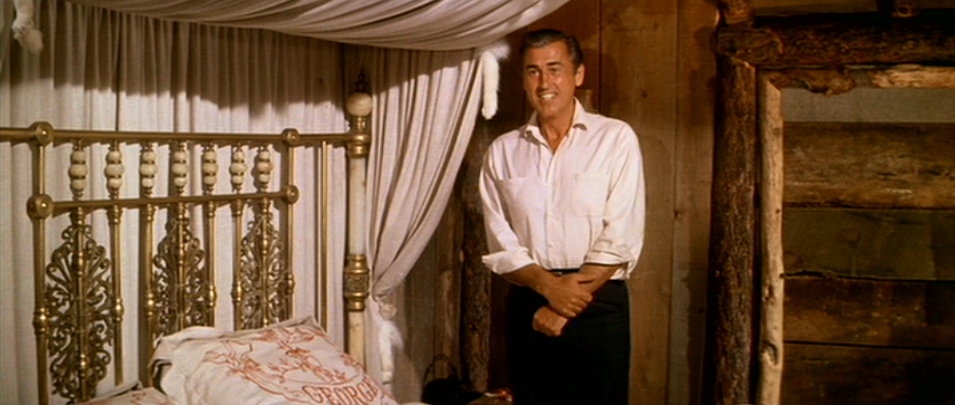 This movie's about two gold miners who strike it rich in Alaska. With wealth in his pocket, George (Granger) is ready to marry his long-pined-for fiancee. He sends Sam (John Wayne) to bring her from Seattle. Only she got tired of waiting and is already married. Sam gets a hair-brained idea to bring another French lady (Capucine) up to Alaska... only he doesn't exactly explain the situation to her, so she's in love with Sam before they reach Alaska. Throw in the gold strike, claim jumpers, and quite a few brawls to the romance, and you've got the plot to North to Alaska.
 Most of my favorite parts of this movie are any time Ernie Kovacs is around. I grew up on re-runs of the Ernie Kovacs Show. We watched his show as often as we could. He was truly a brilliant and gifted comedian, and his show had some absolutely priceless skits on it. We always loved when he set weird stuff to music, like the pencil sharpener whistling "Sentimental Journey," and what we used to call "the spaghetti eating music." And there's Percy Dovetonsils and his awful poetry. And of course, the Nairobi Trio skits were always family favorites, and my sister even dressed up as one of the Nairobi Trio for Halloween one year. Given that I'm not much of a comedy person, Ernie Kovacs was definitely special and a very important figure in my childhood.
 I love him as Frankie Canon in this movie. His constant scheming to make it rich just cracks me up. He watches for any opportunity he can turn to his advantage without having to do any work. He does that smiling "I'm your best friend, really!" routine, while lying and cheating and manipulating anything and everyone he can get away with. I love when Clancy the dog thwarts one of his early attempts. And, of course, I love when he finally gets caught as his final scheme goes awry and he finally gets his comeuppance. It's all very satisfying.
John Wayne and Stewart Granger are great as the gold-mining partners. I love their relationship, and the two actors play well off each other. I think John Wayne is underrated in the comedy department. Capucine is lovely as the love interest. When Granger sets out to drive Wayne's character jealous and prove he loves Capucine's character, Michelle, I just grin and grin. Fabian... well. He's young, rather cute, and annoying as all get out. He's my least favorite part of this movie, but at least he annoys the other characters just as much, so I can live with it.

 The other thing I enjoy about this movie is the scenery. It's filmed partly at Hot Creek, near Mammoth California, a place I've been visiting since I was a little kid. You used to be able to cross the bridge they built for the movie, but it is finally gone and has not been replaced. Hot Creek is one of those places that has a jillion signs saying essentially, "Don't swim here, scalding water," and people still go in the water... and still get burnt or worse every year. Idiots. But it's beautiful there, and I love seeing it in the movie.

(me, at Hot Creek a couple years ago)