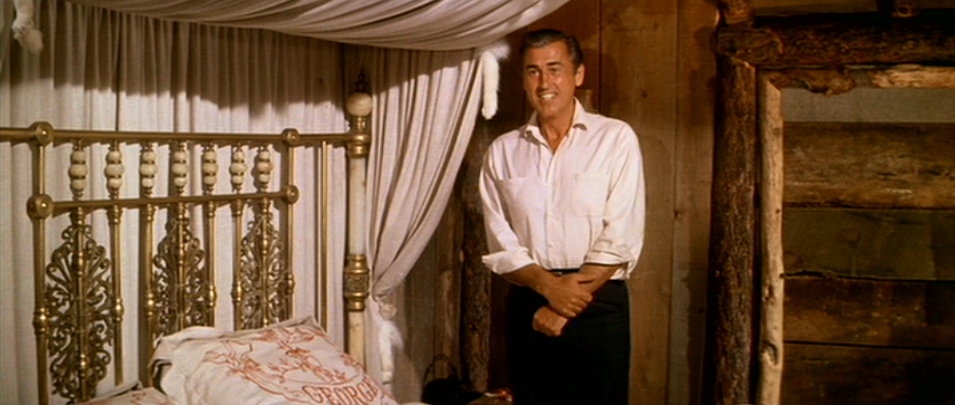
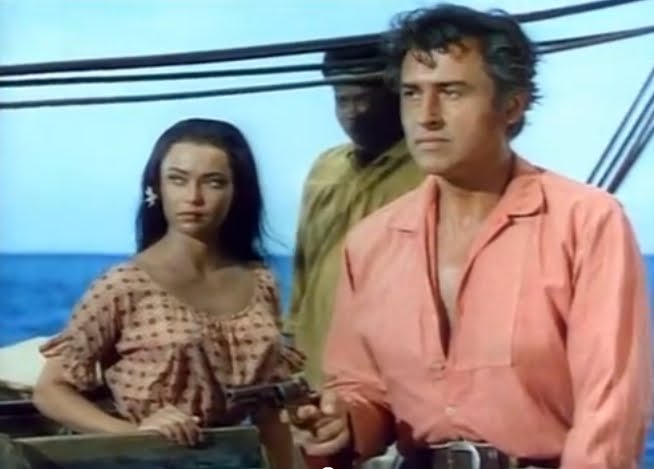
A writer! Amnesia! Quick sand! Love triangles! Revenge! Gypsies! Marrying people you don't love because you think the person you do love is dead!
This movie is ridiculously full of movie cliches, but instead of driving me crazy, I actually found myself enjoying the convoluted combination. I'm not entirely sure why either. This isn't a good movie, by any means, but it is amusing. Maybe it just tickled me that Stewart Granger was playing a writer? Maybe it's because the people making this film seem to be enjoying themselves? Maybe I was just in an accepting and non-judgmental mood?
Stewart Granger plays Richard Darnell, an aspiring writer desperate to sell his novel so he can earn enough money to marry his childhood sweetheart. He saves an older gentleman from thieves, returns him and his nearly-stolen jewelry home, and disappears into the night, not expecting any thank yous. Richard is one of those rare Honest Men. I loved that! The older gentleman, (who is from Spain) however, tracks him down anyway. Not only does he love Richard's book and offers to help him get it published, but he offers Richard a job transporting those jewels to Spain. That's just the opening few minutes. Okay, there's a flashback in there to Richard's youth, showing how the lower class boy meets and falls in love with upper class Oriana, and how her wimpy but scheming and slimy upper class friend, Francis, resents Richard and covets Oriana for himself. This rivalry, of course, carries into adulthood.
Sir Francis (Dennis Price) grows into a vile, loathsome creature who calls himself a man. There doesn't seem to be any depths he won't stoop to to get what he wants, and he wants Oriana (Anne Crawford), though why, I'm not quite sure. He certainly doesn't love her. She loses all her wealth when her father dies, so she doesn't bring him any wealth. I think he wants her simply to spite Richard, who has bested him at every turn his entire life.
Richard takes the job transporting the jewels, but being the honest sort, he puts his trust into a fellow "traveler" named Wycroft that Sir Francis sends along to sabotage and murder Richard. The ratfink very nearly succeeds, and so Richard ends up severely wounded and with amnesia. He's rescued by a lovely gypsy dancer named Rosal (Jean Kent), who falls in love with him (and therefore starts a second love triangle).
And then things get even more complicated and more cliche, and yet, it all ultimately worked for me. It may get complicated, but it's also predictable, not necessarily in a bad way. I found the conclusion satisfactory.
I really liked Stewart Granger in this one. He's nice, sweet, and honest, but then he gets to show off his bitter and broody side later in the movie. I'm quite fond of angry Stewart Granger. He glowers and internalizes so well. Dennis Price was appropriately slimy and nasty. The two ladies were adequate, beautiful and fiesty and fought for what they want. And I really love the name "Rosal."
All in all, I found this movie pretty entertaining.
Showing posts with label actor-Stewart Granger. Show all posts
Monday, September 24, 2012
Monday, September 17, 2012
Madonna of the Seven Moons (1945)
I have been suffering from Stewart Granger withdrawal and so, after a very long absence from watching classic movies, I caught Madonna of the Seven Moons, with Stewart Granger, Phyllis Calvert, and Patricia Roc. I had no idea what this one would be about going in, and I was rather surprised to find a rather serious story under a great deal of melodrama. A few spoilers follow!
Phyllis Calvert plays Maddalena, a young woman who is attacked (and presumed raped) in the opening of the movie. This scars her for life, and, even though she ends up happily married, she develops a split personality as a way of dealing with her fears and trauma. When she's not shy and quiet Maddalena, happily married to wealthy Giuseppe with a very modern daughter, Angela, she runs off and becomes Rosanna, an aggressive and rather fearless peasant woman who has fallen in love with thief Nino (Stewart Granger). Whichever personality she is at the time, she has no memory of her other self. Both personalities are lost souls, though, and if there's one thing Phyllis Calvert is very good at playing, it's lost, doomed souls. She never does find peace from her personal demons, no matter how hard she hides from herself.
Like I said, serious subject, actually. The majority of the movie is about Giuseppe's attempt to understand what happened to his wife and why she does what she does, and Angela's (Maddalena's daughter) search to find her. She's helped by her very respectable boyfriend and his best friend, who is part of an absolutely adorable husband/wife team (I loved them!). They're contrasted by a very disreputable dancer/con artist and a jealous woman who wants Stewart Granger for herself and isn't happen when Rosanna returns. It's rather interesting that all the good guys are upper class, all the bad guys lower... deliberate? Or just because it's convenient to the plot? I have no idea.
The dancer/con artist is a scheming rat named Sandro (Peter Glenville), who is Nino's nasty younger brother. Nino may be a thief, but Sandro can't wait to get Angela alone so he can rape her, and he very nearly succeeds. He's quite slimy and thoroughly loathsome. I thought the parallel between the daughter and Maddalena's own violent past would come into play at some point, but oddly, it doesn't. The ending of the film struck me as not necessarily unsatisfactory, but more of just a "well, that's one way to get out of the situation" ending.
The movie was mostly entertaining, the cast worked well, the heavy melodrama suited their handling of the subject matter, and I think the only reason I wasn't more disturbed was because it was so melodramatic it was hard to take it quite seriously... even if it was serious. Which is all very confusing, I know. But then, I'm still rather confused about how I feel about it. It was definitely interesting, that's for sure.
And Stewart Granger was awfully good-looking in this movie. :-D
Phyllis Calvert plays Maddalena, a young woman who is attacked (and presumed raped) in the opening of the movie. This scars her for life, and, even though she ends up happily married, she develops a split personality as a way of dealing with her fears and trauma. When she's not shy and quiet Maddalena, happily married to wealthy Giuseppe with a very modern daughter, Angela, she runs off and becomes Rosanna, an aggressive and rather fearless peasant woman who has fallen in love with thief Nino (Stewart Granger). Whichever personality she is at the time, she has no memory of her other self. Both personalities are lost souls, though, and if there's one thing Phyllis Calvert is very good at playing, it's lost, doomed souls. She never does find peace from her personal demons, no matter how hard she hides from herself.
Like I said, serious subject, actually. The majority of the movie is about Giuseppe's attempt to understand what happened to his wife and why she does what she does, and Angela's (Maddalena's daughter) search to find her. She's helped by her very respectable boyfriend and his best friend, who is part of an absolutely adorable husband/wife team (I loved them!). They're contrasted by a very disreputable dancer/con artist and a jealous woman who wants Stewart Granger for herself and isn't happen when Rosanna returns. It's rather interesting that all the good guys are upper class, all the bad guys lower... deliberate? Or just because it's convenient to the plot? I have no idea.
The dancer/con artist is a scheming rat named Sandro (Peter Glenville), who is Nino's nasty younger brother. Nino may be a thief, but Sandro can't wait to get Angela alone so he can rape her, and he very nearly succeeds. He's quite slimy and thoroughly loathsome. I thought the parallel between the daughter and Maddalena's own violent past would come into play at some point, but oddly, it doesn't. The ending of the film struck me as not necessarily unsatisfactory, but more of just a "well, that's one way to get out of the situation" ending.
The movie was mostly entertaining, the cast worked well, the heavy melodrama suited their handling of the subject matter, and I think the only reason I wasn't more disturbed was because it was so melodramatic it was hard to take it quite seriously... even if it was serious. Which is all very confusing, I know. But then, I'm still rather confused about how I feel about it. It was definitely interesting, that's for sure.
And Stewart Granger was awfully good-looking in this movie. :-D
Friday, April 06, 2012
The Lamp Still Burns (1943)
I quite liked this little drama, about a female and successful architect who drops everything to become a nurse during WWII. Rosamund John is very likeable as the protagonist, Hilary Clarke. When she decides she wants to help people as a nurse instead, she commits fully with passion and perseverance. I can't help but admire someone willing to give up everything for the hardships and privations nurses-in-training had to go through.
Stewart Granger seems ridiculously young in this movie, and while his is definitely a supporting role, it's still a critical one. His character, Laurence Rains, works with Hilary in the beginning of the film when she's still in her architect capacity, and he's quite taken with her, even though he's engaged to another woman. He next encounters her when there's an accident at his plant, and then things go terribly wrong and he and his fiancee both get caught in an explosion at his plant and end up in the hospital Hilary is training at, under her care. The rest of the story deals with how the love triangle intersects with Hilary's commitment to the nursing profession.
I did not know how harsh and strict the conditions for nurses in England at this time was. The sheer amount restrictions and rules are astounding. Definitely not something I could have done, which just made me admire Hilary even more. I love strong, passionate female characters. She is faced with some horrible decisions that no one should have to make. I quite liked the other nurses as well, and the various patients all had personalities. It's a movie I will definitely watch again at some point.
It's funny. I watch plenty of movie violence and it doesn't bother me, but one long scene in this movie, a surgery -- which shows ZERO gore or blood -- got to me. It was more the sounds and concept of what was going on that wigged me out. I'm sure the fact that it was Laurence Rains on the operating table was a big part of it. Since this wasn't a Hollywood movie and happy endings are not remotely guaranteed in British movies, I had no idea if he'd make it, and worrying over his character was freaking me out. I think that was one of the strong points of this movie: I cared a very great deal about all the characters. The movie made their fates matter to me, and I love that about the film. (And did he make it, you ask? Well, you'll just have to watch the movie!)
Stewart Granger seems ridiculously young in this movie, and while his is definitely a supporting role, it's still a critical one. His character, Laurence Rains, works with Hilary in the beginning of the film when she's still in her architect capacity, and he's quite taken with her, even though he's engaged to another woman. He next encounters her when there's an accident at his plant, and then things go terribly wrong and he and his fiancee both get caught in an explosion at his plant and end up in the hospital Hilary is training at, under her care. The rest of the story deals with how the love triangle intersects with Hilary's commitment to the nursing profession.
I did not know how harsh and strict the conditions for nurses in England at this time was. The sheer amount restrictions and rules are astounding. Definitely not something I could have done, which just made me admire Hilary even more. I love strong, passionate female characters. She is faced with some horrible decisions that no one should have to make. I quite liked the other nurses as well, and the various patients all had personalities. It's a movie I will definitely watch again at some point.It's funny. I watch plenty of movie violence and it doesn't bother me, but one long scene in this movie, a surgery -- which shows ZERO gore or blood -- got to me. It was more the sounds and concept of what was going on that wigged me out. I'm sure the fact that it was Laurence Rains on the operating table was a big part of it. Since this wasn't a Hollywood movie and happy endings are not remotely guaranteed in British movies, I had no idea if he'd make it, and worrying over his character was freaking me out. I think that was one of the strong points of this movie: I cared a very great deal about all the characters. The movie made their fates matter to me, and I love that about the film. (And did he make it, you ask? Well, you'll just have to watch the movie!)
Thursday, April 05, 2012
Salome (1953)
I admit it: I'm a sucker for Biblical epics. Good or bad, overblown or great, melodramatic or understated or just perfect... I tend to enjoy them all. I love the vivid colors, the sumptuous costumes, the setting, the hair styles. Salome was more enjoyable than I expected. Hard to go wrong with the cast: Charles Laughton, Judith Anderson, Stewart Granger, and Rita Hayworth in the lead roles. But the script surprised me with some really good dialogue. That's not to say it didn't have its over-the-top factor (John the Baptist... I'm looking at you and your wild eyes!), but that's also part of the fun of Biblical epics.
I wasn't quite sure how Stewart Granger would fit in when I started watching, but they worked him in all right, and he had plenty of screen time in his Roman outfits to keep me happy. And really, they certainly paired Granger up with some of the most lovely women in Hollywood! What a handsome couple he and Rita make!
Spoilers follow...
The plot surprised me a bit. I guess I've gotten used to Rita playing the femme fatale types, and Salome and her dance of the seven veils for the head of John the Baptist just all fit together nicely with that image... only they changed that. In this version, she dances to save him! Knock me over with a feather, what?? That was unexpected. I was also expecting her to somehow get Stewart Granger's character killed... she's good at that, and he's good at picking the wrong women and getting killed because of it... nope. They both seem to live happily ever after, and together, no less! The entire ending rather shocked me. Not that I object to happy endings, quite the contrary, it just didn't fit with the story of Salome I was expecting. I mean, who thinks "good girl" when they think of Salome?
Granger's character was also a good guy, though that I was expecting. His Roman Commander Claudius has secretly converted to Christianity, so he helps slaves, John the Baptist, and whoever else he can, getting himself kicked out of the Roman army when he openly admits it to his boss (Pontius Pilate, played with strength and unexpected compassion -- at least when around Granger -- by Basil Sydney, who I last saw playing Captain Smollett in the 1950 version of Treasure Island, really like him!). That was one of the small things that bugged me though. Claudius is ordered to take ship for Rome, and he promptly goes AWOL instead, returning to Galilee. And nothing comes from this open defiance of his orders. It's only his friendship with Pilate that prevented him from being executed for treason in the first place, and no one follows to arrest him or anything?? And he's still looking awfully Roman in the last shot of the film, no hiding out by blending in with the natives. Too bad. I'd kind of like to see a few consequences from his desertion. But, of course, I daydream. This movie is not called "Claudius," it's called "Salome."
All in all, it was a diverting couple of hours, and definitely better than quite a few other movies in this genre, and it fits the season. I think I automatically start looking for these types of movies come Easter, as television stations used to run the gamut of Biblical epics this time of year.
I wasn't quite sure how Stewart Granger would fit in when I started watching, but they worked him in all right, and he had plenty of screen time in his Roman outfits to keep me happy. And really, they certainly paired Granger up with some of the most lovely women in Hollywood! What a handsome couple he and Rita make!
Spoilers follow...The plot surprised me a bit. I guess I've gotten used to Rita playing the femme fatale types, and Salome and her dance of the seven veils for the head of John the Baptist just all fit together nicely with that image... only they changed that. In this version, she dances to save him! Knock me over with a feather, what?? That was unexpected. I was also expecting her to somehow get Stewart Granger's character killed... she's good at that, and he's good at picking the wrong women and getting killed because of it... nope. They both seem to live happily ever after, and together, no less! The entire ending rather shocked me. Not that I object to happy endings, quite the contrary, it just didn't fit with the story of Salome I was expecting. I mean, who thinks "good girl" when they think of Salome?
(Good Salome?)
Granger's character was also a good guy, though that I was expecting. His Roman Commander Claudius has secretly converted to Christianity, so he helps slaves, John the Baptist, and whoever else he can, getting himself kicked out of the Roman army when he openly admits it to his boss (Pontius Pilate, played with strength and unexpected compassion -- at least when around Granger -- by Basil Sydney, who I last saw playing Captain Smollett in the 1950 version of Treasure Island, really like him!). That was one of the small things that bugged me though. Claudius is ordered to take ship for Rome, and he promptly goes AWOL instead, returning to Galilee. And nothing comes from this open defiance of his orders. It's only his friendship with Pilate that prevented him from being executed for treason in the first place, and no one follows to arrest him or anything?? And he's still looking awfully Roman in the last shot of the film, no hiding out by blending in with the natives. Too bad. I'd kind of like to see a few consequences from his desertion. But, of course, I daydream. This movie is not called "Claudius," it's called "Salome."
All in all, it was a diverting couple of hours, and definitely better than quite a few other movies in this genre, and it fits the season. I think I automatically start looking for these types of movies come Easter, as television stations used to run the gamut of Biblical epics this time of year.Wednesday, April 04, 2012
Sparks Fly Upward, by Stewart Granger
I'm not much of a biography reader, but after reading this interview on TCM MovieMorlocks blog, I knew I wanted to read this book. This quote from Stewart Granger in particular just really spoke to me:"Even the happy periods are unhappy to write about because you say to yourself, 'Why the hell didn't I know I was happy then?'"
And I LOVED this book. Really loved it. He may have described writing the book as torture, but he has a very easy writing style to read, and his way of describing things is often very funny. I laughed out loud. A lot.
The only problem with this book is that it ends. And he leaves off his story in 1960, right after he made North to Alaska. Perhaps there was going to be a second book, but alas, it was never written. Too bad, as I was so not ready to leave his world and would happily have read about the next set of years.
He has many adventures, but I think what I loved most about him is how normal he was, and how much about him I could relate to, such as our shared problem of a nervous stomach, and how many things scared him. I think I might even have loved his stories about non-Hollywood stuff more than the movie-related stories. Such as his early life, and buying a ranch in New Mexico, then Arizona, and the trials and tribulation of learning to raise cattle. I commented in my last post on how happy his character was in North to Alaska. Boy, that couldn't have been farther from his real mood at the time that movie was filmed (going through divorce from Jean Simmons), which only makes me appreciate that exuberant performance even more.
He had great stories about the crazy filming of King Solomon's Mines. About exploding planes and grabbing a cobra for a shot... only to find out its fangs were not taped back like they were supposed to be. Yikes! I was very impressed with how Jean Simmons took Howard Hughes to court -- and won! Some of the sad parts of his story broke my heart. Life is not always kind to any of us, that's for sure.
I actually don't have the book in front of me right now (I forced it, er... lent it... to my sister, after I loved it so much and I really wanted someone else to read it... even if she has no clue who Stewart Granger is, LOL!), so I can't quote some of my favorite sections right now. But there were a lot. From memory, I think my absolute favorite bit was when he first arrived in Hollywood and Cary Grant took him to the Farmers Market. This was after the war, but food had still been heavily rationed in England, and Stewart Granger just flipped out over all the food on display for sale at the Farmers Market. He bought all this stuff he couldn't possibly eat all of, just because he could and he'd gone without for so long, with a bemused Cary Grant looking on wondering what the heck. I also loved a bit about him commenting on the static electricity and getting painfully shocked by anything metal. I forget that it's not this dry elsewhere in the world, and that that might actually be a new experience for someone, not something you live with.
Anyway, I'd rank this as the most enjoyable autobiography (or biography) I've read, and it really made me like him even more as a person than just the handsome, swashbuckling actor from the movies. Highly recommended for anyone interested in either Stewart Granger or old Hollywood.
Saturday, March 31, 2012
North to Alaska (1960)
North to Alaska is not exactly a good movie, but it's quite fun if you just go with the flow. I've seen this one a few times over the years, but recently watched it again, as I'm still catching Stewart Granger films. I've gotten kind of used to Granger being broody and darker, so his sheer good-naturedness and happy exuberance in this movie made me grin. He's so very cheerful. Reminded me of Van Heflin's hilarious line in Three Musketeers to Gene Kelly: "Will you stop looking happy?" But it all works well in this movie.
This movie's about two gold miners who strike it rich in Alaska. With wealth in his pocket, George (Granger) is ready to marry his long-pined-for fiancee. He sends Sam (John Wayne) to bring her from Seattle. Only she got tired of waiting and is already married. Sam gets a hair-brained idea to bring another French lady (Capucine) up to Alaska... only he doesn't exactly explain the situation to her, so she's in love with Sam before they reach Alaska. Throw in the gold strike, claim jumpers, and quite a few brawls to the romance, and you've got the plot to North to Alaska.
Most of my favorite parts of this movie are any time Ernie Kovacs is around. I grew up on re-runs of the Ernie Kovacs Show. We watched his show as often as we could. He was truly a brilliant and gifted comedian, and his show had some absolutely priceless skits on it. We always loved when he set weird stuff to music, like the pencil sharpener whistling "Sentimental Journey," and what we used to call "the spaghetti eating music." And there's Percy Dovetonsils and his awful poetry. And of course, the Nairobi Trio skits were always family favorites, and my sister even dressed up as one of the Nairobi Trio for Halloween one year. Given that I'm not much of a comedy person, Ernie Kovacs was definitely special and a very important figure in my childhood.
I love him as Frankie Canon in this movie. His constant scheming to make it rich just cracks me up. He watches for any opportunity he can turn to his advantage without having to do any work. He does that smiling "I'm your best friend, really!" routine, while lying and cheating and manipulating anything and everyone he can get away with. I love when Clancy the dog thwarts one of his early attempts. And, of course, I love when he finally gets caught as his final scheme goes awry and he finally gets his comeuppance. It's all very satisfying.
John Wayne and Stewart Granger are great as the gold-mining partners. I love their relationship, and the two actors play well off each other. I think John Wayne is underrated in the comedy department. Capucine is lovely as the love interest. When Granger sets out to drive Wayne's character jealous and prove he loves Capucine's character, Michelle, I just grin and grin. Fabian... well. He's young, rather cute, and annoying as all get out. He's my least favorite part of this movie, but at least he annoys the other characters just as much, so I can live with it.

The other thing I enjoy about this movie is the scenery. It's filmed partly at Hot Creek, near Mammoth California, a place I've been visiting since I was a little kid. You used to be able to cross the bridge they built for the movie, but it is finally gone and has not been replaced. Hot Creek is one of those places that has a jillion signs saying essentially, "Don't swim here, scalding water," and people still go in the water... and still get burnt or worse every year. Idiots. But it's beautiful there, and I love seeing it in the movie.
This movie's about two gold miners who strike it rich in Alaska. With wealth in his pocket, George (Granger) is ready to marry his long-pined-for fiancee. He sends Sam (John Wayne) to bring her from Seattle. Only she got tired of waiting and is already married. Sam gets a hair-brained idea to bring another French lady (Capucine) up to Alaska... only he doesn't exactly explain the situation to her, so she's in love with Sam before they reach Alaska. Throw in the gold strike, claim jumpers, and quite a few brawls to the romance, and you've got the plot to North to Alaska.
Most of my favorite parts of this movie are any time Ernie Kovacs is around. I grew up on re-runs of the Ernie Kovacs Show. We watched his show as often as we could. He was truly a brilliant and gifted comedian, and his show had some absolutely priceless skits on it. We always loved when he set weird stuff to music, like the pencil sharpener whistling "Sentimental Journey," and what we used to call "the spaghetti eating music." And there's Percy Dovetonsils and his awful poetry. And of course, the Nairobi Trio skits were always family favorites, and my sister even dressed up as one of the Nairobi Trio for Halloween one year. Given that I'm not much of a comedy person, Ernie Kovacs was definitely special and a very important figure in my childhood.
I love him as Frankie Canon in this movie. His constant scheming to make it rich just cracks me up. He watches for any opportunity he can turn to his advantage without having to do any work. He does that smiling "I'm your best friend, really!" routine, while lying and cheating and manipulating anything and everyone he can get away with. I love when Clancy the dog thwarts one of his early attempts. And, of course, I love when he finally gets caught as his final scheme goes awry and he finally gets his comeuppance. It's all very satisfying.John Wayne and Stewart Granger are great as the gold-mining partners. I love their relationship, and the two actors play well off each other. I think John Wayne is underrated in the comedy department. Capucine is lovely as the love interest. When Granger sets out to drive Wayne's character jealous and prove he loves Capucine's character, Michelle, I just grin and grin. Fabian... well. He's young, rather cute, and annoying as all get out. He's my least favorite part of this movie, but at least he annoys the other characters just as much, so I can live with it.

The other thing I enjoy about this movie is the scenery. It's filmed partly at Hot Creek, near Mammoth California, a place I've been visiting since I was a little kid. You used to be able to cross the bridge they built for the movie, but it is finally gone and has not been replaced. Hot Creek is one of those places that has a jillion signs saying essentially, "Don't swim here, scalding water," and people still go in the water... and still get burnt or worse every year. Idiots. But it's beautiful there, and I love seeing it in the movie.
(me, at Hot Creek a couple years ago)
Labels:
actor-John Wayne,
actor-Stewart Granger,
movies,
westerns
Saturday, February 25, 2012
Gun Glory (1957)
Ah, a Stewart Granger Western. Finally. This one co-stars Rhonda Fleming, Chill Wills, and James Gregory. I enjoyed it a lot, particularly the last twenty minutes. The rest of it is pretty standard Western fare, but the ending action and confrontations upped this movie a bit for me. It was just the right level of rousing and exciting and went exactly the way I wanted it to go to end satisfactorily.
Granger plays Tom Early, a man who turned to gambling and gunfighting and abandoned his wife and son and who is now seeking to return home and make amends. He has, of course, That Reputation, the one that young men fast with a gun want to challenge, the one the makes Early unfit company in a law-abiding town. The bitter, local shopkeeper (Jacques Aubuchon) wants Early out of town, especially when Jo (Rhonda Fleming), who lives at the general store, treats Early nicely. Chill Wills plays the local preacher who tries to keep the peace among everyone.
But Early has returned home too late, and he finds his wife has died and his son is now a young man full of bitter resentment at being abandoned. Early sets about trying to reconcile with Tom Junior. The son is played by Steve Rowland, and I personally felt he was the weakest link in the film. Not the character of the son, but the actor portraying him. He just didn't seem to fit the role he was playing.

The cool part of the movie is the main antagonist: James Gregory, playing one of those wealthy, I-can-do-what-I-want types that he's so good at. He intends to drive his herd of 20,000 cattle right through the valley where the new town is located on his way to the railroad -- right over the farmers that have have deeds and legal rights to that land, including Early. This was kind of different, and I really enjoyed the conscienceless James Gregory's attitude: "There weren't any people here the last time I drove cattle through, too bad they're here now, but they're in my way..." Having his cattle feed on their rich farmlands to fatten up is a nice bonus for him. His character of Grimsell is really quite despicable. Of course, he hadn't counted on Early (who he knows) living and owning land in this particular town, and he knows where the townspeople couldn't stop him on their best day, Early poses a distinct problem to his plan.
And so the fun begins.
I really loved everything having to do with the Cattleman vs. Town main plot. I loved how Chill Wills' preacher tries everything in his power to settle things honestly and legally and protect his people. I loved every time Gregory and Granger had a confrontation. I particularly love everything about Granger's single-handed plan to thwart James Gregory and how it plays out. It's pretty darned awesome. These are the strong points in the movie. Intermixed with those are the inevitable love story between Rhonda Fleming and Granger, and the father/son resentment/reconciliation. The script does nicely weave everything together so the subplots play into the main plot to reach the final outcome, so I really shouldn't complain. I just loved the action so much I wanted more of it. Granger fit very well in Western territory, I'm pleased to say, and I'm looking forward to more.
Granger plays Tom Early, a man who turned to gambling and gunfighting and abandoned his wife and son and who is now seeking to return home and make amends. He has, of course, That Reputation, the one that young men fast with a gun want to challenge, the one the makes Early unfit company in a law-abiding town. The bitter, local shopkeeper (Jacques Aubuchon) wants Early out of town, especially when Jo (Rhonda Fleming), who lives at the general store, treats Early nicely. Chill Wills plays the local preacher who tries to keep the peace among everyone.
But Early has returned home too late, and he finds his wife has died and his son is now a young man full of bitter resentment at being abandoned. Early sets about trying to reconcile with Tom Junior. The son is played by Steve Rowland, and I personally felt he was the weakest link in the film. Not the character of the son, but the actor portraying him. He just didn't seem to fit the role he was playing.
The cool part of the movie is the main antagonist: James Gregory, playing one of those wealthy, I-can-do-what-I-want types that he's so good at. He intends to drive his herd of 20,000 cattle right through the valley where the new town is located on his way to the railroad -- right over the farmers that have have deeds and legal rights to that land, including Early. This was kind of different, and I really enjoyed the conscienceless James Gregory's attitude: "There weren't any people here the last time I drove cattle through, too bad they're here now, but they're in my way..." Having his cattle feed on their rich farmlands to fatten up is a nice bonus for him. His character of Grimsell is really quite despicable. Of course, he hadn't counted on Early (who he knows) living and owning land in this particular town, and he knows where the townspeople couldn't stop him on their best day, Early poses a distinct problem to his plan.
And so the fun begins.I really loved everything having to do with the Cattleman vs. Town main plot. I loved how Chill Wills' preacher tries everything in his power to settle things honestly and legally and protect his people. I loved every time Gregory and Granger had a confrontation. I particularly love everything about Granger's single-handed plan to thwart James Gregory and how it plays out. It's pretty darned awesome. These are the strong points in the movie. Intermixed with those are the inevitable love story between Rhonda Fleming and Granger, and the father/son resentment/reconciliation. The script does nicely weave everything together so the subplots play into the main plot to reach the final outcome, so I really shouldn't complain. I just loved the action so much I wanted more of it. Granger fit very well in Western territory, I'm pleased to say, and I'm looking forward to more.
Friday, February 24, 2012
Moonfleet (1955)
Love the title of this film, though I was a bit disconcerted to find out it's just the name of the town in the film. This was a very dark movie, quite literally as well as figuratively-- there's only one scene filmed in daylight! This film drips with creepy, gothic atmosphere, accentuated by... guess what! Another Miklos Rozsa score! This film offers one of the creepiest statues I've ever seen. It was directed by Fritz Lang.
This film tells the tale of a newly orphaned boy, John Mohune (Jon Whiteley), sent by the dying request of his mother to stay with Jeremy Fox (Granger). Fox and the mother had fallen in love in their youth, with dire consequences for both. The mother presumes upon that brief, painful past to find a home for her son from a marriage to another man. Fox is wealthy, unmarried, dissolute, and leads a secret life -- wants no part of being responsible for a child. But John impresses Fox enough with his spunk that he ends up keeping him on. When John stumbles onto Fox's secret -- he's the ringleader for a bunch of smugglers in town -- Fox opts to send the kid to America, but things rapidly start going wrong. There's also various subplots. One about a lost treasure dovetails nicely with the smuggling aspect. There's multiple betrayals, some exciting escapes and chases, and that oppressive darkness that pervades everything.
I quite enjoyed this movie. Granger's a bitter, but self-assured and selfish bastard on the surface, but the movie gives him quite a bit of complexity beneath that. He has a sad, violent back story that explains why he won't let himself love anyone or care about anything anymore. His harsh past also explains why he leads the smugglers now. And because he has that past, and he slips and lets show what kind of a good man he could have been if fate hadn't derailed him, he maintained my sympathy throughout the film. The boy, of course, gets to him, brings out the better side of him. I liked their relationship, how much the boy sticks up for Fox, despite how Fox initially treats him. I liked watching priorities and goals shift for Fox throughout the film, how he changes because of both the boy and circumstances. Redemption is one of those themes of which I simply never tire.
There's one nice sword fight in the film... where Granger's opponent cheats and grabs a poleaxe instead of the proffered sword! Eep! Was a little worried how that lopsided match would turn out!
The always excellent George Sanders co-stars as an aristocratic friend of Jeremy Fox, who isn't exactly on the side of right himself. And Joan Greenwood, who was Granger's co-star in Saraband for Dead Lovers, is in this film as Sanders' wife, who also very openly and brazenly chases Granger. I can't say there's that many honest or upstanding people in this film! A young but unmistakeable Jack Elam has a small humorous part as one of the smugglers. And the poleaxe-bearing opponent is played by Sean McClory, who I love in Plunder of the Sun.

So, good cast, very creepy direction, great score, great dialogue... all in all, I have to say I really liked it. I watched this one on youtube and would really like to see it again on DVD (not sure it's available), as it was so dark on my computer monitor, I couldn't always make out the details. I think viewed on my television, it'd be considerably brighter.
I'd be remiss if I didn't add how much I have always loved this time period's clothes -- and how well Granger wears them. I think this is my favorite time period look for him, from the pigtail and tri-cornered hats, to the shirts and boots. Just adore it.
Which leads me into one other thought, switching topics... All those not interested in opera... fell free to click away now!
Since I'm such an opera lover, and since Tosca is my favorite opera, my sister and I often play casting games, where we try to select various sets of people to put in the lead roles. Sometimes it's combinations of opera singers who never performed together, sometimes it's actors. Tyrone Power is still my idea of the perfect cinematic Mario Cavaradossi (I went on about that once here). And I've always thought Deborah Kerr would make a perfect Floria Tosca. Scarpia has always been trickier, because there's so many different types of Scarpias, whereas the two protagonists are pretty cut and dried. So, depending on the dynamics I'm craving in Act 2, I often settle on very different casting choices. George Sanders would make an absolutely ideal Scarpia, along the Cornell MacNeil lines -- elegant and scheming, his dangerous, evil side camouflaged by that oh-so-suave exterior. So also, I realized while watching this movie, would Stewart Granger play a perfect cinematic Scarpia, but he's more the Sherill Milnes type -- more outright threatening physically, charming but not so smoothly urbane, and twice as dangerous a villain because he's sexy on top of it all.
In Moonfleet, Granger's character's entrance was so much like Scarpia's entrance in Tosca that I was singing Scarpia's first words "Un tal baccano in chiesa! Bel rispetto!" for him. Kind of shocked me when he didn't start speaking Italian like the moment required. LOL! But the flung-open door, the pose, the whip, the outfit, the expression of distaste... wow. Quite utterly perfect. I haven't had the chance to share that entrance with my sister, but I can't wait to!
This film tells the tale of a newly orphaned boy, John Mohune (Jon Whiteley), sent by the dying request of his mother to stay with Jeremy Fox (Granger). Fox and the mother had fallen in love in their youth, with dire consequences for both. The mother presumes upon that brief, painful past to find a home for her son from a marriage to another man. Fox is wealthy, unmarried, dissolute, and leads a secret life -- wants no part of being responsible for a child. But John impresses Fox enough with his spunk that he ends up keeping him on. When John stumbles onto Fox's secret -- he's the ringleader for a bunch of smugglers in town -- Fox opts to send the kid to America, but things rapidly start going wrong. There's also various subplots. One about a lost treasure dovetails nicely with the smuggling aspect. There's multiple betrayals, some exciting escapes and chases, and that oppressive darkness that pervades everything.
I quite enjoyed this movie. Granger's a bitter, but self-assured and selfish bastard on the surface, but the movie gives him quite a bit of complexity beneath that. He has a sad, violent back story that explains why he won't let himself love anyone or care about anything anymore. His harsh past also explains why he leads the smugglers now. And because he has that past, and he slips and lets show what kind of a good man he could have been if fate hadn't derailed him, he maintained my sympathy throughout the film. The boy, of course, gets to him, brings out the better side of him. I liked their relationship, how much the boy sticks up for Fox, despite how Fox initially treats him. I liked watching priorities and goals shift for Fox throughout the film, how he changes because of both the boy and circumstances. Redemption is one of those themes of which I simply never tire.
There's one nice sword fight in the film... where Granger's opponent cheats and grabs a poleaxe instead of the proffered sword! Eep! Was a little worried how that lopsided match would turn out!The always excellent George Sanders co-stars as an aristocratic friend of Jeremy Fox, who isn't exactly on the side of right himself. And Joan Greenwood, who was Granger's co-star in Saraband for Dead Lovers, is in this film as Sanders' wife, who also very openly and brazenly chases Granger. I can't say there's that many honest or upstanding people in this film! A young but unmistakeable Jack Elam has a small humorous part as one of the smugglers. And the poleaxe-bearing opponent is played by Sean McClory, who I love in Plunder of the Sun.

So, good cast, very creepy direction, great score, great dialogue... all in all, I have to say I really liked it. I watched this one on youtube and would really like to see it again on DVD (not sure it's available), as it was so dark on my computer monitor, I couldn't always make out the details. I think viewed on my television, it'd be considerably brighter.
I'd be remiss if I didn't add how much I have always loved this time period's clothes -- and how well Granger wears them. I think this is my favorite time period look for him, from the pigtail and tri-cornered hats, to the shirts and boots. Just adore it.Which leads me into one other thought, switching topics... All those not interested in opera... fell free to click away now!
Since I'm such an opera lover, and since Tosca is my favorite opera, my sister and I often play casting games, where we try to select various sets of people to put in the lead roles. Sometimes it's combinations of opera singers who never performed together, sometimes it's actors. Tyrone Power is still my idea of the perfect cinematic Mario Cavaradossi (I went on about that once here). And I've always thought Deborah Kerr would make a perfect Floria Tosca. Scarpia has always been trickier, because there's so many different types of Scarpias, whereas the two protagonists are pretty cut and dried. So, depending on the dynamics I'm craving in Act 2, I often settle on very different casting choices. George Sanders would make an absolutely ideal Scarpia, along the Cornell MacNeil lines -- elegant and scheming, his dangerous, evil side camouflaged by that oh-so-suave exterior. So also, I realized while watching this movie, would Stewart Granger play a perfect cinematic Scarpia, but he's more the Sherill Milnes type -- more outright threatening physically, charming but not so smoothly urbane, and twice as dangerous a villain because he's sexy on top of it all.
In Moonfleet, Granger's character's entrance was so much like Scarpia's entrance in Tosca that I was singing Scarpia's first words "Un tal baccano in chiesa! Bel rispetto!" for him. Kind of shocked me when he didn't start speaking Italian like the moment required. LOL! But the flung-open door, the pose, the whip, the outfit, the expression of distaste... wow. Quite utterly perfect. I haven't had the chance to share that entrance with my sister, but I can't wait to!
Thursday, February 23, 2012
All the Brothers Were Valiant (1953)
Another Stewart Granger movie right up my alley. This time in the sailing/South Sea Island vein. I quite enjoyed this movie, which had another nice score by Miklos Rozsa.
Robert Taylor also stars in this movie, as Granger's younger brother, which was weird, as Taylor looks older to me (and I think he was older in real life), but whatever. They were believable as brothers Mark (Granger) and Joel Shore(Taylor), scions of a long line of seafaring Shores.
The movie opens with Joel returning to port and finding Mark missing and presumed dead in the Gilbert Islands. There's some sordid tales spinning through the seamen on the ship Mark captained, about Mark skipping out on his crew. Joel won't accept any insult to his brother, however, and defends Mark's honor with fists when necessary.
Joel is given Mark's ship and becomes her new captain, and he immediately sets sail for the Gilberts to find out what happened to his lost brother. Ann Blyth plays Pris, the girl both brothers loved. With Mark out of the picture, she marries Joel, and sails with him on their three-year cruise! That rather surprised me. Who takes a woman on a whaling ship??
Of course, when they get to the Gilberts, Mark turns up alive and well with a wild story to tell. Mark's story was my favorite part of the movie, naturally! Just all Stewart Granger, friendly and unfriendly South Sea islands, a native girl he falls in love with, and a shifty-eyed bunch of pearl hunters looking to make it big that he falls in with accidentally. The wealth the pearls offer fuels the last portion of this movie, with Mark fully intent on recovering his loot, and Joel fully intent on continuing his whaling mission. Neither brother is willing to back down, so things get quite interesting at the end of the movie.
Like I said, Mark's story told in flashback was my favorite section, but there were quite a few other moments I really loved. When Mark finds out Joel has married Pris in his "presumed dead" absence, the look he shoots Joel is pure hatred. It's so strong a look I half expect Robert Taylor to burst into flames or something. Remind me never to make Stewart Granger mad! LOL! I loved most of the scenes between the two brothers, as they verbally spar with each other. There's a great scene where Mark takes special delight in telling his brother that he took Joel's toys away when they were kids, and he can still do it now. To Joel's credit, he doesn't rise to the bait, but if there's one thing Robert Taylor's really good at, it's being stolid and unflappable. And I loved when Joel finally decks Mark (hm, I see to enjoy watching Granger get knocked down... at least when he totally deserves it.). I loved the action-packed end of the movie too.
Other things I loved about this movie: the wonderful James Whitmore as one of the scroungy, scheming pearl hunters. Absolutely loved him, plotting quietly, acting decisively when he's ready. There's a desperate fight between him and Granger that I loved, even if I had to watch it through my fingers (I have this thing about knives being grabbed by the blade...). John Lupton is also in this film, in a small role as a seaman, and I dig him too. And Ann Blyth's character doesn't get in the way too much, so I didn't mind her along for the ride as much as I thought I would.
All in all, a rather different movie and quite enjoyable. I'd definitely watch it again.


Robert Taylor also stars in this movie, as Granger's younger brother, which was weird, as Taylor looks older to me (and I think he was older in real life), but whatever. They were believable as brothers Mark (Granger) and Joel Shore(Taylor), scions of a long line of seafaring Shores.
The movie opens with Joel returning to port and finding Mark missing and presumed dead in the Gilbert Islands. There's some sordid tales spinning through the seamen on the ship Mark captained, about Mark skipping out on his crew. Joel won't accept any insult to his brother, however, and defends Mark's honor with fists when necessary.Joel is given Mark's ship and becomes her new captain, and he immediately sets sail for the Gilberts to find out what happened to his lost brother. Ann Blyth plays Pris, the girl both brothers loved. With Mark out of the picture, she marries Joel, and sails with him on their three-year cruise! That rather surprised me. Who takes a woman on a whaling ship??
Of course, when they get to the Gilberts, Mark turns up alive and well with a wild story to tell. Mark's story was my favorite part of the movie, naturally! Just all Stewart Granger, friendly and unfriendly South Sea islands, a native girl he falls in love with, and a shifty-eyed bunch of pearl hunters looking to make it big that he falls in with accidentally. The wealth the pearls offer fuels the last portion of this movie, with Mark fully intent on recovering his loot, and Joel fully intent on continuing his whaling mission. Neither brother is willing to back down, so things get quite interesting at the end of the movie.
Like I said, Mark's story told in flashback was my favorite section, but there were quite a few other moments I really loved. When Mark finds out Joel has married Pris in his "presumed dead" absence, the look he shoots Joel is pure hatred. It's so strong a look I half expect Robert Taylor to burst into flames or something. Remind me never to make Stewart Granger mad! LOL! I loved most of the scenes between the two brothers, as they verbally spar with each other. There's a great scene where Mark takes special delight in telling his brother that he took Joel's toys away when they were kids, and he can still do it now. To Joel's credit, he doesn't rise to the bait, but if there's one thing Robert Taylor's really good at, it's being stolid and unflappable. And I loved when Joel finally decks Mark (hm, I see to enjoy watching Granger get knocked down... at least when he totally deserves it.). I loved the action-packed end of the movie too.Other things I loved about this movie: the wonderful James Whitmore as one of the scroungy, scheming pearl hunters. Absolutely loved him, plotting quietly, acting decisively when he's ready. There's a desperate fight between him and Granger that I loved, even if I had to watch it through my fingers (I have this thing about knives being grabbed by the blade...). John Lupton is also in this film, in a small role as a seaman, and I dig him too. And Ann Blyth's character doesn't get in the way too much, so I didn't mind her along for the ride as much as I thought I would.
All in all, a rather different movie and quite enjoyable. I'd definitely watch it again.

Monday, February 13, 2012
Green Fire (1954)
Yowza, what an opening! Stewart Granger finds an old Conquistador mine that holds the promise of emeralds, then gets bushwhacked, shot, whacked unconscious, thrown down a mountain. When he comes to, he’s very nearly lunch for a jaguar. And that’s just the first five minutes of this movie! Certainly right up my alley, and I was hooked.
Alas, then the rest of the movie happened...
No, I don't really mean that. It was entertaining and I enjoyed it all, but it's hard to live up to an action-packed beginning like this film has, and it soon bogged down in romance. Granted, the romance is between Stewart Granger and Grace Kelly! Now, there's a ridiculously good-looking couple! Anyway, there's quite a bit good about this movie. In particular: Paul Douglas. I absolutely love Paul Douglas in everything I've seen him in, and he's far and away the best part of this movie. He gets all the cool dialogue and made me laugh quite a few times, he gets to save the day more than once, he gets to be the emotional center of the film, and he gets to deck Stewart Granger... As long as Paul Douglas was around, I was very happy with this movie.
But let's back up... Stewart Granger plays Rian Mitchell, a miner looking for that one big strike that will make him rich. He thinks he may have found it with the conquistador mine's potential for emeralds, but he needs money to mine it properly. His long-suffering partner, Vic (Paul Douglas), is just about to head for a nice stable job in Canada. Naturally, Granger has to muck up those plans so his partner (and his partner's money) support him. Granger's playing a charming (is he ever not??), but rather unscrupulous and very, very selfish man. He uses everyone around him, manipulating anyone gullible enough to fall for his line, so he can pursue his emeralds. I thought Granger was prefect in his role, just the right ruthless line, just the right charisma to get away with it, and just enough guilt to make me still like him.
Grace Kelly plays the hardworking owner of a coffee plantation that lies below the mine. She's trying desperately to make the place profitable. She has a younger brother, played by John Ericson. Naturally, Kelly and Granger fall in love. Naturally, his selfishness causes tragedy and ends up pitting the two against each other. There's also some local bandits, led by Murvyn Vye, who wants the emeralds -- but are perfectly willing to let Granger do all the work first, then come take the precious gems later. There's plenty more action, and a spectacular finish, and really, it was quite entertaining... I shouldn't have any complaints... but something never entirely gels to make this movie anything more than simply entertaining. I can't quite put my finger on it, though, since romance is my least favorite genre, I tend to want to point my finger at the romance in this film, perhaps unfairly. But it seems a bit unreal, and there's less chemistry between the two leads than I would like (I really like Grace Kelly, but she seems a bit uncomfortable in this movie), and I really don't get why she wants to stick with Granger when all is said in done. Not when Paul Douglas is so much more wonderful. There's definitely a Hollywood gloss to the proceedings. (The brother is also very annoying.)
But this movie still quite entertained me.
There's a really nice score by Miklos Rozsa, though what's up with the song sung over the credits? Ugh! It's a liberal helping of schmaltz that does not remotely fit this movie. Ah well, it's short, and the rest of the score is nice.
Also, some great location shooting down in Columbia really helped ground the movie.
Did I mention Paul Douglas was awesome? :-D
Alas, then the rest of the movie happened...
No, I don't really mean that. It was entertaining and I enjoyed it all, but it's hard to live up to an action-packed beginning like this film has, and it soon bogged down in romance. Granted, the romance is between Stewart Granger and Grace Kelly! Now, there's a ridiculously good-looking couple! Anyway, there's quite a bit good about this movie. In particular: Paul Douglas. I absolutely love Paul Douglas in everything I've seen him in, and he's far and away the best part of this movie. He gets all the cool dialogue and made me laugh quite a few times, he gets to save the day more than once, he gets to be the emotional center of the film, and he gets to deck Stewart Granger... As long as Paul Douglas was around, I was very happy with this movie.
But let's back up... Stewart Granger plays Rian Mitchell, a miner looking for that one big strike that will make him rich. He thinks he may have found it with the conquistador mine's potential for emeralds, but he needs money to mine it properly. His long-suffering partner, Vic (Paul Douglas), is just about to head for a nice stable job in Canada. Naturally, Granger has to muck up those plans so his partner (and his partner's money) support him. Granger's playing a charming (is he ever not??), but rather unscrupulous and very, very selfish man. He uses everyone around him, manipulating anyone gullible enough to fall for his line, so he can pursue his emeralds. I thought Granger was prefect in his role, just the right ruthless line, just the right charisma to get away with it, and just enough guilt to make me still like him.
Grace Kelly plays the hardworking owner of a coffee plantation that lies below the mine. She's trying desperately to make the place profitable. She has a younger brother, played by John Ericson. Naturally, Kelly and Granger fall in love. Naturally, his selfishness causes tragedy and ends up pitting the two against each other. There's also some local bandits, led by Murvyn Vye, who wants the emeralds -- but are perfectly willing to let Granger do all the work first, then come take the precious gems later. There's plenty more action, and a spectacular finish, and really, it was quite entertaining... I shouldn't have any complaints... but something never entirely gels to make this movie anything more than simply entertaining. I can't quite put my finger on it, though, since romance is my least favorite genre, I tend to want to point my finger at the romance in this film, perhaps unfairly. But it seems a bit unreal, and there's less chemistry between the two leads than I would like (I really like Grace Kelly, but she seems a bit uncomfortable in this movie), and I really don't get why she wants to stick with Granger when all is said in done. Not when Paul Douglas is so much more wonderful. There's definitely a Hollywood gloss to the proceedings. (The brother is also very annoying.)
But this movie still quite entertained me.There's a really nice score by Miklos Rozsa, though what's up with the song sung over the credits? Ugh! It's a liberal helping of schmaltz that does not remotely fit this movie. Ah well, it's short, and the rest of the score is nice.
Also, some great location shooting down in Columbia really helped ground the movie.
Did I mention Paul Douglas was awesome? :-D
Friday, February 10, 2012
Saraband for Dead Lovers (1948)
Well, if the movie’s title doesn’t tell you this is not a happy movie, the opening intertitle further tells you that you’re about to see a tragic historic tale. And if that doesn’t clue you in that there’s no rainbows and flowers, then the depressing opening scene (which is really the end of the story), just hammers it home even more. Most of the movie is told in flashback form.
This movie is the story of Sophie Dorothea of Celle, who was forced into an unhappy marriage for political reasons with George Louis, Elector of Hanover, (and isn’t Elector a great title?), who eventually became king of Great Britain. After she met a Swedish foreigner, Count Philip Konigsmark, she was locked away in a castle for thirty years. This movie is a fictional account of that unhappy marriage and how she fell in love with the Count.

The Count is, of course, played by Stewart Granger. And you know the minute he sees Sophie Dorothea, played with desperate vulnerability by Joan Greenwood, that he's as doomed as she is.
Despite the doom and gloom, I rather enjoyed this film, mostly because the cast is so superb. My favorite character was the Electress, played with steely, unforgiving resolve by Francoise Rosay. She is so cold and determined to get one thing - the British throne for her family. And yet, in one one beautiful scene, she softens just enough to show that she, too, is as miserable as the heroine, she's just learned to hide it behind a wall of ruthlessness. Politics and happiness have nothing to do with each other in this court, and she counsels the young woman to give up all thoughts of happiness. There is some very fine dialogue between the characters.
Another fascinating character is the Countess Clara Platen, played with delicious manipulative slyness by Flora Robson. She does a lot of the political manuevering behind the scenes, and she also has an eye for Granger's character. (Who wouldn't?) When he falls for Sophie, you know Clara's not going to take that too well.
Peter Bull makes George Louis into quite the callous, despicable future king, and Anthony Quayle, as Durer, lurks in the shadows biding his time to strike for power. It really is a perfect cast for these historic roles. They're all very believable and fitting. The costumes are magnificent, the castle sets look great.
Stewart Granger gets one sword fight, a little too short for me, but still a good one, as he takes on four men alone.
This film tells of a historical time period I'm not particularly familiar with, so I enjoyed it from that aspect as well. A sad time, a sad story, and I admit, one moment at the end got me a wee bit teary-eyed. My favorite scene, besides the sword fight, is when a deliciously angry Stewart Granger attempts to get George Louis riled up enough to duel him. Granger, all storm clouds and challenge, Bull as George Louis all bored and I-really-don't-give-a-damn-about-your-insults. It's a fun, intense scene.
This movie is the story of Sophie Dorothea of Celle, who was forced into an unhappy marriage for political reasons with George Louis, Elector of Hanover, (and isn’t Elector a great title?), who eventually became king of Great Britain. After she met a Swedish foreigner, Count Philip Konigsmark, she was locked away in a castle for thirty years. This movie is a fictional account of that unhappy marriage and how she fell in love with the Count.

The Count is, of course, played by Stewart Granger. And you know the minute he sees Sophie Dorothea, played with desperate vulnerability by Joan Greenwood, that he's as doomed as she is.
Despite the doom and gloom, I rather enjoyed this film, mostly because the cast is so superb. My favorite character was the Electress, played with steely, unforgiving resolve by Francoise Rosay. She is so cold and determined to get one thing - the British throne for her family. And yet, in one one beautiful scene, she softens just enough to show that she, too, is as miserable as the heroine, she's just learned to hide it behind a wall of ruthlessness. Politics and happiness have nothing to do with each other in this court, and she counsels the young woman to give up all thoughts of happiness. There is some very fine dialogue between the characters.
Another fascinating character is the Countess Clara Platen, played with delicious manipulative slyness by Flora Robson. She does a lot of the political manuevering behind the scenes, and she also has an eye for Granger's character. (Who wouldn't?) When he falls for Sophie, you know Clara's not going to take that too well.
Peter Bull makes George Louis into quite the callous, despicable future king, and Anthony Quayle, as Durer, lurks in the shadows biding his time to strike for power. It really is a perfect cast for these historic roles. They're all very believable and fitting. The costumes are magnificent, the castle sets look great.
Stewart Granger gets one sword fight, a little too short for me, but still a good one, as he takes on four men alone.
This film tells of a historical time period I'm not particularly familiar with, so I enjoyed it from that aspect as well. A sad time, a sad story, and I admit, one moment at the end got me a wee bit teary-eyed. My favorite scene, besides the sword fight, is when a deliciously angry Stewart Granger attempts to get George Louis riled up enough to duel him. Granger, all storm clouds and challenge, Bull as George Louis all bored and I-really-don't-give-a-damn-about-your-insults. It's a fun, intense scene.
Thursday, January 26, 2012
Blanche Fury (1948)
Hm, I'm still not quite sure whether I liked this movie or not. It's a little bit of everything, and I think I would have preferred something more... I'm not sure what the word is... clear cut? Or perhaps what keeps it interesting is that it's all over the board? It's hard to explain what I mean.
The brief synopsis without spoilers... Blanche (Valerie Hobson), tired of her poor and lowly positions as nurse/companion/house servant to a series of old ladies, receives a notice that her uncle would like her to come home and take a position as governess for her young cousin, Lavinia. The new position brings considerable more money with it, and ambitious for wealth and stability, Blanche marries her cousin, Lawrence(Michael Gough), which gives her the Fury surname... which her cousins appear to have appropriated from the previous, true owners of the estate when they left no legitimate heir. Things are complicated by the presence of Philip Thorn (Stewart Granger), who is the illegitimate son of the last Fury. He's quite bitter over not owning the estate himself and having to be groundskeeper for the usurpers. Blanche falls for him, even though she marries the other guy. Complications, illicit romance, murder, courtroom drama, perhaps a supernatural curse result from this mix of characters.
Okay, that wasn't brief at all! It's all quite complicated, which I admit I liked.
I think the movie just confused me because I kept flipflopping on how I reacted to the characters. In the first scenes, Blanche is so unpleasant, that I wondered how I'd make it through a movie with her as the lead. Then she turned really nice. Then she turned a bit mean again. Then she turned nice... it was odd. Same with Philip, played with lovely, simmering anger by Stewart Granger. He seems rightfully angry, then he takes it a couple steps too far, then a few steps really too far, then he comes back and I like him again... So I never could decide if I liked or disliked these people.
On the clear dislike list: Michael Gough as Lawrence was quite the despicable character, and he played it marvelously. On the clear like list: Lavinia (Suzanne Gibbs) was sweet and nice the whole time.
Then there's the whole possible curse on the estate, always lurking in the background. I rather enjoyed that. Gave the film a bit of a Gothic, horror cast to it that fit well with the mansion's dark shadowy corners and the sordid deeds of the plot.
There's a whole courtroom section... I didn't like that. Of course, it's a very very very rare film that makes me like anything set in a courtroom.
I did love the two lead actors. They did a great job and worked played well off each other. Valerie Hobson had the right look for her character: beautiful and austere, but soft when she needed to be. Stewart Granger was full of sharp edges, all dangerous and broody and stormy (except when his character was around horses, then he would turn gentle). His character had just one obsessive goal and watching his schemes turn darker and darker to achieve it was fascinating. I think the fact that he is so darned handsome makes his role work even better, because you want to like and trust him, even when he's scowling and plotting. I would have been more than a bit terrified of him, if I were in that movie.

It was definitely an engrossing film, and I wasn't sure how it would end, which is also something I liked about this movie. I should also mention the score by Clifton Parker, which was really neat and fit the movie perfectly. I loved the main theme in particular. Wouldn't mind owning this score on CD at all. It set the scene and the mood perfectly. And there was an intriguing use of color! Look at this shot, all blue, red, white. Very striking.
The brief synopsis without spoilers... Blanche (Valerie Hobson), tired of her poor and lowly positions as nurse/companion/house servant to a series of old ladies, receives a notice that her uncle would like her to come home and take a position as governess for her young cousin, Lavinia. The new position brings considerable more money with it, and ambitious for wealth and stability, Blanche marries her cousin, Lawrence(Michael Gough), which gives her the Fury surname... which her cousins appear to have appropriated from the previous, true owners of the estate when they left no legitimate heir. Things are complicated by the presence of Philip Thorn (Stewart Granger), who is the illegitimate son of the last Fury. He's quite bitter over not owning the estate himself and having to be groundskeeper for the usurpers. Blanche falls for him, even though she marries the other guy. Complications, illicit romance, murder, courtroom drama, perhaps a supernatural curse result from this mix of characters.
Okay, that wasn't brief at all! It's all quite complicated, which I admit I liked.
I think the movie just confused me because I kept flipflopping on how I reacted to the characters. In the first scenes, Blanche is so unpleasant, that I wondered how I'd make it through a movie with her as the lead. Then she turned really nice. Then she turned a bit mean again. Then she turned nice... it was odd. Same with Philip, played with lovely, simmering anger by Stewart Granger. He seems rightfully angry, then he takes it a couple steps too far, then a few steps really too far, then he comes back and I like him again... So I never could decide if I liked or disliked these people.On the clear dislike list: Michael Gough as Lawrence was quite the despicable character, and he played it marvelously. On the clear like list: Lavinia (Suzanne Gibbs) was sweet and nice the whole time.
Then there's the whole possible curse on the estate, always lurking in the background. I rather enjoyed that. Gave the film a bit of a Gothic, horror cast to it that fit well with the mansion's dark shadowy corners and the sordid deeds of the plot.
There's a whole courtroom section... I didn't like that. Of course, it's a very very very rare film that makes me like anything set in a courtroom.
I did love the two lead actors. They did a great job and worked played well off each other. Valerie Hobson had the right look for her character: beautiful and austere, but soft when she needed to be. Stewart Granger was full of sharp edges, all dangerous and broody and stormy (except when his character was around horses, then he would turn gentle). His character had just one obsessive goal and watching his schemes turn darker and darker to achieve it was fascinating. I think the fact that he is so darned handsome makes his role work even better, because you want to like and trust him, even when he's scowling and plotting. I would have been more than a bit terrified of him, if I were in that movie.

It was definitely an engrossing film, and I wasn't sure how it would end, which is also something I liked about this movie. I should also mention the score by Clifton Parker, which was really neat and fit the movie perfectly. I loved the main theme in particular. Wouldn't mind owning this score on CD at all. It set the scene and the mood perfectly. And there was an intriguing use of color! Look at this shot, all blue, red, white. Very striking.I think now, after writing this up, that I want to see it again. Now that I know the plot and the characters and how it wraps up, I think I'd like to go back and see how it fit together.